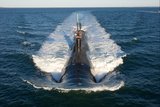
Raytheon integrates mid-course and terminal guidance for Maritime Strike Tomahawk
Block V Tomahawk launch from USS Chafee in November 2020. (Photo: USN/Ensign Sean Ianno)
Raytheon obtains Tomahawk Block Va contract modification from NAVAIR.


Raytheon Technologies is to integrate, produce, qualify, test and field Tomahawk Block Va (Maritime Strike Tomahawk - MST) seeker suites and all subsystems required to provide mid-course and terminal guidance, under a $19.59 million contract modification from US Naval Air Systems Command (NAVAIR).
‘The procured quantity of seeker suites will be installed in recertified Tomahawk missiles for the Navy,’ the DoD announced on 29 October, adding that work is expected to be completed by October 2024.
All Tomahawk Block IVs in USN service are being upgraded to the Block V/Va/Vb configuration with a longer range, dynamic targeting and (in the case of MST) the capability to hit vessels at sea.
In this context, MST was name-checked by ADM Philip Davidson, head of the US Indo-Pacific Command (INDOPACOM) during a Senate Armed Services Committee appearance in March 2021 as one of the crucial weapon systems required for US forces in the region.
The UK RN is also installing the missile on its Type 26 (City-class) frigates and MST is also earmarked for the future Canadian Surface Combatant.
Related Equipment in Defence Insight

You may also like

More from Naval Warfare
-
![RTX confirms US Marine Corps and US Navy acquire Hadalus UUV]()
RTX confirms US Marine Corps and US Navy acquire Hadalus UUV
RTX told Shephard that the Hadalus UUV has been procured by the US Marine Corps and the Office of Naval Research for operational experimentation as the company prepares additional demonstrations with the US Navy, NATO and AUKUS partners.
-
![The UK joins the movement towards joint procurement]()
The UK joins the movement towards joint procurement
The UK will spend an estimated US$3.89 billion over the next decade in joint naval programmes, a lot of which will be in cooperation with Norway.
-
![Rheinmetall’s GMF 140: Ambitious frigate or market misfit?]()
Rheinmetall’s GMF 140: Ambitious frigate or market misfit?
Rheinmetall has unveiled its first next-generation frigate design, showing ambitions to compete as a surface combatant prime contractor. While the company is targeting North America, analysts believe the concept may be better positioned for future European programmes.
-
![US Navy $76.6bn award provides stability for submarine production]()
US Navy $76.6bn award provides stability for submarine production
The US Department of War’s US$76.6 billion Columbia-and Virginia-class submarine contract gives industry demand certainty as Washington seeks to rebuild its shipbuilding base.