Raytheon minehunting sonar to equip US Navy LCS


Raytheon will provide the US Navy with AN/AQS-20A minehunting sonar systems and equipment for deployment on the force’s Littoral Combat Ship (LCS) as part of a $35.5 million contract announced on 3 March.
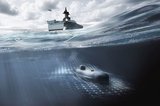
As the variable depth sonar for the AN/WLD-1 Remote Minehunting System (RMS), the AN/AQS-20A system is towed undersea to scan the water in front, below and to the sides of the vehicle for anti-shipping mines. Sophisticated sonar, electro-optical sensors, and high-precision location information are used to provide high-resolution images of mines and mine-like objects.
Kevin Peppe, vice president of Seapower Capability Systems, Raytheon’s Integrated Defense Systems business, said: ‘An essential component of LCS, AN/AQS-20A advances the capability of the ship’s mine countermeasure arsenal. Enhanced to optimise detection - in both range and accuracy, AN/AQS-20A provides the navy with the advantage they need to safely detect and effectively identify these undersea threats.’
The system can be used to support mine-clearing operations in both deep-ocean and littoral waters; and according to the company, the AN/AQS-20A is the only minehunting sonar sensor developed, tested and certified for Remote Multi Mission Vehicle (RMMV) deployment.

More from Naval Warfare
-
![China’s mineral processing dominance exposes naval supply chain vulnerabilities]()
China’s mineral processing dominance exposes naval supply chain vulnerabilities
Competition for critical minerals, and China’s dominance of their processing, is emerging as a decisive factor in future naval procurement programmes.
-
![Suppliers await next step in Australia’s mine warfare transition]()
Suppliers await next step in Australia’s mine warfare transition
Australia’s mine countermeasure capability remains in flux as the Huon-class nears retirement, but accelerated investment in autonomous systems is opening a path for industry.
-
![Can the US Navy ask Indo-Pacific allies to do more while training with them less?]()
Can the US Navy ask Indo-Pacific allies to do more while training with them less?
As the Iran War draws US ships and marine corps units away from the Indo-Pacific, curtailed exercises and a temporary carrier gap are exposing tensions between Washington’s demand for more self-reliant allies and the joint training needed to realise that ambition.
-
![How could Rheinmetall’s GMF 140 fit with ongoing programmes in North America?]()
How could Rheinmetall’s GMF 140 fit with ongoing programmes in North America?
With Canada committed to its River-class replacement and the USN pursuing a lower-cost frigate, Rheinmetall will need to demonstrate where the GMF 140 can fill a capability gap in the North American fleet.
-
![Australian industry programme builds pipeline for Virginia-class sustainment]()
Australian industry programme builds pipeline for Virginia-class sustainment
Australian businesses can now bid to support Virginia-class submarine sustainment in Western Australia, as momentum around the Henderson Defence Precinct also builds.