Quantum Marine Stabilizers – Introduces Latest 5000S Control System (Sponsored)
Bollinger Shipyards – Sentinel-Class Fast Response Cutters (FRC)
The Quantum 5000S truly represents a “Quantum Leap” in control technology as it integrates with the existing control systems as well as future systems. With the modular design, it offers flexibility to customization and is sourced with readily available components.


Though stabilizers have been around since the 1930’s, the technology in recent decades has exploded, especially with active systems. Unlike passive bilge keels, anti-roll tanks or fixed fins, active stabilizer systems are driven by formulas or algorithms that control the movement of the fin or rotor underwater. Whether a vessel is underway or operating at zero speed, Quantum Stabilizer Systems can significantly reduce the roll, and minimize onboard motion, in order to improve safety and overall operations at a higher sea state. Stabilizers provide obvious benefits when it comes to offensive missions, helicopter landings, refueling underway and rescue efforts, but today there are other challenges today with asymmetric threats. Combating these threats with every possible defensive advantage is essential in today’s unpredictable world.
Stabilizer Functionality
The proprietary control technology represents the brains or intellect that processes data which directs the appropriate movements to the fin or rotor all starting with a roll sensor. The roll sensor detects a change in the movement status of a vessel. From the sensor, the roll angle is then transmitted along with the roll rate and velocity which is sent to the main controller for processing. The main controller sends the appropriate response to counteract the roll with the optimal fin or rotor movement and the necessary hydraulic pressure with little to no human input at all. There are many other sources of information and data that are used to define the algorithms and parameters including the natural roll period, vessel speed, metacentric height (GM), displacement, beam and sea state.
Over the last 37 years, Quantum Marine Stabilizers has developed three different control systems: ARC Series, SMC Series and now the latest break through, the 5000S. Many years of experience, listening to customer feedback, using model testing data and Computation Fluid Dynamics (CFD) analysis were all contributors to the control innovations. In the development of the new system, production costs and sourcing components that were readily available was a top priority. Furthermore, it processes data in real time speed and is able to withstand the inevitable caustic marine environments.
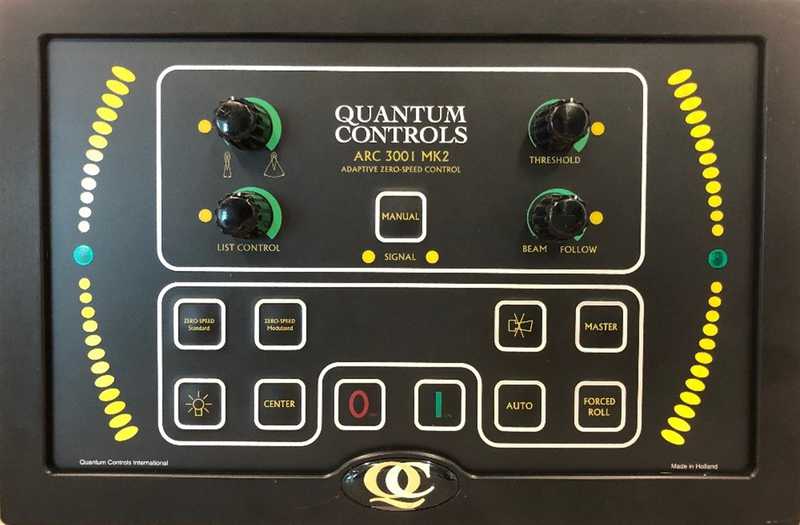
ARC3000 Series
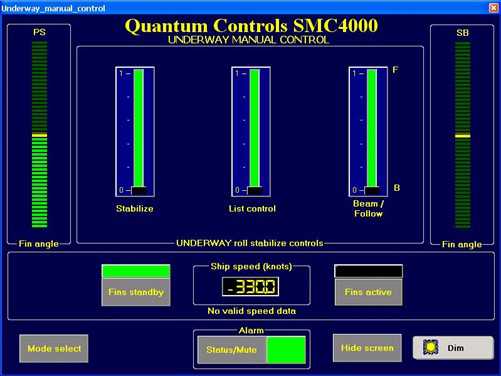
SMC4000 Series
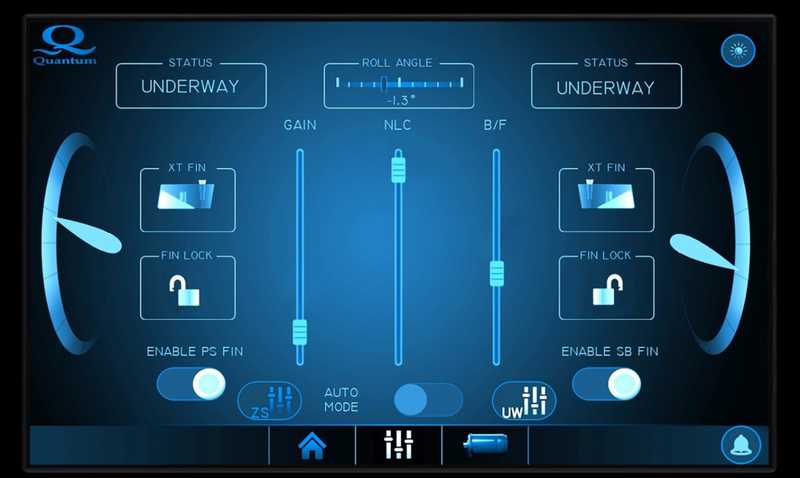
Latest Control – 5000S
Expandable Capabilities
Unlike any other control to date, the 5000S is built on a modular platform, giving it the ability to support old, current and future control generations. Likewise, it can be configured to support the most basic, underway only systems as well as Zero Speed™ technology and some of the more advanced stabilizer systems developed in recent years. To do this economically, the controller was designed to have plug in/add on modules to increase capacity when needed and minimizing the cost of construction for the less complex units. The new technology can be uploaded directly on to a vessel that is already in service.
Remote Access
Remote Access, defined as the ability for Quantum to conduct service and support remotely, is a key advantage to the end user in reducing system down time and avoiding billable, travel expenses. For security purposes, the internet modules are individually registered, and licensing fees are paid by Quantum. System access is only possible through a dedicated, in-house server at Quantum. When on-board band width is limited, the 5000S has recording capabilities that can be stored and downloaded later.
Interface
The 5000S interface is via a hi def 10” TFT - High-Performance Sunlight-Readable Display with an option for a standard 15” monitor in the engine room. The system is also equipped with an interface for glass bridge systems were upon the client can create their own visual graphics to control and monitor the system from the ships common screen interface. The system has the ability to support multiple touch screens, all with full system control and monitoring capabilities.
Other Features
The system provides recommendations on individual control settings and how to adjust those settings. The controls can also store critical information about the system, including, but not limited to project specific drawings, technical manual information, fluid recommendations etc.
The 5000S represents a “Quantum Leap” forward with a platform that supports all control generations, is expandable and will stand the test of time for many years to come.
For more information click here.


More from Industry Spotlights
-
![Patria OPTIME and ILIAS: Orchestrating operational readiness across every domain]()
Patria OPTIME and ILIAS: Orchestrating operational readiness across every domain
Patria OPTIME is a sustainment concept that integrates MRO and lifecycle services into one solution, powered by the ILIAS digital defence platform
-
![“Start planning much earlier”: delivering defence support in an era of disruption]()
“Start planning much earlier”: delivering defence support in an era of disruption
In Conversation… The geopolitical landscape is increasingly uncertain, with the UK and its allies confronting the most unpredictable international environment for decades. To adapt, defence readiness must begin long before assets reach the front line, forging a resilient support enterprise that can thrive in a time of ongoing disruption, argue the partners of Team ORION.
-
![Patria NEMO Navy: Unlocking unmatched versatility and protection for modern naval forces]()
Patria NEMO Navy: Unlocking unmatched versatility and protection for modern naval forces
The Patria NEMO Navy mortar system marks a revolutionary advance in maritime defence technology, offering unparalleled benefits to customers who demand performance, adaptability and safety in their naval operations.
-
![“Communicating at mission speed”: why data security is essential for operational success]()
“Communicating at mission speed”: why data security is essential for operational success
In conversation… Everfox’s Chairman and Chief Executive Officer Dave Wajsgras and Managing Director, International, Colin McKinty discuss the critical importance of information security in defence, minimising insider risk and the company’s international growth strategy with Shephard’s Andrew White.
-
![“Engage with the operational problem”: how software innovation can boost UK defence]()
“Engage with the operational problem”: how software innovation can boost UK defence
In Conversation… Shephard’s Andrew White talks to Zafer Şen, CEO and co-founder of OBSS, about the future of command-and-control software in the age of artificial intelligence, and his company’s ambitions in the UK defence market.