Boeing delivers first Orca UUV to US Navy
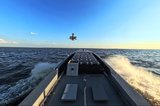
Boeing has been building five Orcas for the US Navy. (Photo: Boeing)
Boeing’s Orca, a large uncrewed submarine which builds upon the company’s work with Echo Voyager, has been designed to provide long-range autonomous operations.


Boeing has delivered the first Orca Extra Large Uncrewed Undersea Vehicle (XLUUV) to the US Navy (USN) following completion of testing earlier this month.
Orca has been described by its manufacturer as a new class of autonomous submarine that can perform long duration critical missions and support naval forces.
Boeing began work on Orca when it started development of Echo Voyager as a proof-of-concept XLUUV and testing of the system began in 2017. Boeing has been building five Orcas for the USN in partnership with Huntington Ingalls Industries.
Related Articles
US Navy’s Orca programme concludes design reviews
Boeing continues DARPA Hunter XLUUV work
Boeing completes Orca large UUV trials and moves to next stage
Echo Voyager, described by Boeing as ‘the world’s only vehicle of its size and capability’, has spent more than 10,000 hours operating at sea, during which time it has transited hundreds of nautical miles autonomously.
Boeing Maritime and Intelligence Systems vice-president Ann Stevens said: ‘This is the culmination of more than a decade of pioneering work, developing a long-range, fully autonomous undersea vehicle with a large payload capacity that can operate completely independently of a host vehicle.’
In August 2023 Boeing announced it had completed the integration of a 10.4m payload section of its Orca built under a DARPA contract and was preparing to go back out to sea for further trials with the payload section. The integrated version is approximately 26m long and weighs more than 73,000kg.
In July 2022, Boeing received an US$8.51 million contract modification from DARPA for Option 3 of the Hunter Phase 2 programme taking the total cumulative face value of the contract to $36.8 million.
Related Equipment in Defence Insight

More from Naval Warfare
-
![Australian industry programme builds pipeline for Virginia-class sustainment]()
Australian industry programme builds pipeline for Virginia-class sustainment
Australian businesses can now bid to support Virginia-class submarine sustainment in Western Australia, as momentum around the Henderson Defence Precinct also builds.
-
![South Korea, Japan and Turkey vie for US shipbuilding access in future frigate contest]()
South Korea, Japan and Turkey vie for US shipbuilding access in future frigate contest
Washington’s search for a foreign-built frigate could hand South Korea, Japan and Turkey a larger prize than a double-hull order: a foothold inside the US shipbuilding industrial base.
-
![German Navy’s Israeli missile test points to deepening defence-industrial ties]()
German Navy’s Israeli missile test points to deepening defence-industrial ties
The test-firing of an Israel Aerospace Industries LORA ballistic missile from a German vessel highlights the Bundeswehr’s focus on speed to capability as it trials Israel’s operationally proven technology.