Oboe landing craft receives independent ‘structural approval’
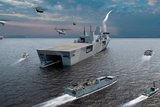
A computer-generated image of the Oboe landing craft disgorging a LARC-V-type vehicle at sea. (Photo: Australian Maritime Alliance)
Serco Australia and Civmec are touting their Oboe landing craft for an Australian Army tender.


On 6 July, the Australian Maritime Alliance (AMA) – a teaming of Serco Australia and Civmec – announced that its design for the Australian Army’s Littoral Manoeuvre Vessel - Medium (LMV-M) had been granted ‘structural approval in principle’.
This approval came from the class certification society DNV.
AMA is offering its Oboe landing craft for this army Project Land 8710 Phase 1A requirement.
The JV stated: ‘The Oboe’s size, load carry capacity and structural integrity will allow the Australian Defence Force to confidently deploy and operate these vessels under all environmental conditions, offering the Australian Army an immediate step-change in operational capability and bringing the inherent design flexibility to meet the challenges of the future.’
Clint Thomas, Serco Defence’s MD, said, ‘This design represents the next generation in amphibious capability for Army and, with a stellar line up of the best Australian industry has to offer, AMA is set to deliver just that.’
The Australian Army requires up to 18 new LMV-Ms to replace its 15 or so LCM-8s. The other contenders are Birdon; Navantia Australia teamed with UGL; and Raytheon Australia with Austal and BMT.
Thomas promised that the Oboe platform would exceed army requirements and operational criteria.
If successful in the tender, AMA would construct the Oboe at Civmec’s shipyard in Henderson, Western Australia.
Related Programmes in Defence Insight
Littoral Manoeuvre Vessel - Medium (Project Land 8710 Phase 1A) [Australia]
Related Equipment in Defence Insight

More from Naval Warfare
-
![Industry sees opportunity in Australia’s shift to networked undersea warfare]()
Industry sees opportunity in Australia’s shift to networked undersea warfare
Australia’s new defence innovation strategy indicates a shift from platform-centric to network-centric undersea warfare, with Ocius and Anduril Industries pointing to fast-growing opportunities for local industry.
-
![Asia-Pacific emerges as the largest export market for US-made USVs]()
Asia-Pacific emerges as the largest export market for US-made USVs
Asian customers have placed one of the largest known international purchases of US-built uncrewed surface vessels, highlighting accelerating regional demand for autonomous maritime capabilities and distributed naval operations.
-
![The UK joins the movement towards joint procurement]()
The UK joins the movement towards joint procurement
The UK will spend an estimated US$3.89 billion over the next decade in joint naval programmes, a lot of which will be in cooperation with Norway.