Nigeria’s Homeland orders additional patrol vessels


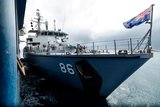
Nigeria-based Homeland Integrated Offshore Services has ordered two additional Fast Crew Supplier (FCS) 3307 patrol vessels from the Damen Group, a year after it received the second FCS 3307, the company announced on 17 March.
The vessels will be named as Guardian 3 and Guardian 4. The Damen Group will take care of delivery and crew training, as well as the design and build of the vessels.
The two new Guardians will be used to carry out security patrols for the production companies and occasional transfers of crew and supplies. The 33m vessels will be designed to match the technical requirements of the production companies. The vessels have a top speed of 30 knots, which is five knots faster than the specification.
The vessels will be equipped with 18 bunks for crew and security personnel, who can remain on board for up to four weeks. The wheelhouse is a bullet-proof and additional equipment includes 15 seats for crew transfers, thermal imaging, a diesel powered SOLAS fast rescue craft and an additional fuel separator to protect the engines and generators from contaminated fuel.
Louis Ekere, managing director, Homeland, said: ‘Both us and our clients have been delighted with the performance of our first two FCS 3307 Patrol vessels. They remain the most capable craft of their type operating off the coast of Nigeria and we already have charter contracts lined up for both of them. Having the support of the Damen Local Service Hub gives us the utmost confidence that they will consistently operate at full capacity and capability.’

You may also like

More from Naval Warfare
-
![China’s mineral processing dominance exposes naval supply chain vulnerabilities]()
China’s mineral processing dominance exposes naval supply chain vulnerabilities
Competition for critical minerals, and China’s dominance of their processing, is emerging as a decisive factor in future naval procurement programmes.
-
![Suppliers await next step in Australia’s mine warfare transition]()
Suppliers await next step in Australia’s mine warfare transition
Australia’s mine countermeasure capability remains in flux as the Huon-class nears retirement, but accelerated investment in autonomous systems is opening a path for industry.
-
![Can the US Navy ask Indo-Pacific allies to do more while training with them less?]()
Can the US Navy ask Indo-Pacific allies to do more while training with them less?
As the Iran War draws US ships and marine corps units away from the Indo-Pacific, curtailed exercises and a temporary carrier gap are exposing tensions between Washington’s demand for more self-reliant allies and the joint training needed to realise that ambition.
-
![How could Rheinmetall’s GMF 140 fit with ongoing programmes in North America?]()
How could Rheinmetall’s GMF 140 fit with ongoing programmes in North America?
With Canada committed to its River-class replacement and the USN pursuing a lower-cost frigate, Rheinmetall will need to demonstrate where the GMF 140 can fill a capability gap in the North American fleet.
-
![Australian industry programme builds pipeline for Virginia-class sustainment]()
Australian industry programme builds pipeline for Virginia-class sustainment
Australian businesses can now bid to support Virginia-class submarine sustainment in Western Australia, as momentum around the Henderson Defence Precinct also builds.
-
![South Korea, Japan and Turkey vie for US shipbuilding access in future frigate contest]()
South Korea, Japan and Turkey vie for US shipbuilding access in future frigate contest
Washington’s search for a foreign-built frigate could hand South Korea, Japan and Turkey a larger prize than a double-hull order: a foothold inside the US shipbuilding industrial base.