Malaysia considers whether to stick or twist with LCS


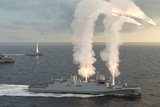
The Malaysian Ministry of Defence (MINDEF) is mulling how to proceed with its troubled Maharaja Lela -class Littoral Combat Ship (LCS) programme.
None of the six LCS vessels on order from Boustead Naval Shipyard have been successfully completed, Defence Minister Datuk Seri Ismail Sabri Yaacob told parliament on 3 August.
LCS 1 is almost 60% completed, ahead of LCS 2 (48%), LCS 3 (43.75%), LCS 4 (36.49%) and LCS 5 (20%). Construction of LCS 6 is yet to begin.
This means that the overall programme is some 31 months behind schedule, Ismail Sabri said, and costs are spiralling beyond the original MYR9.13 billion ($2.16 billion) contract ceiling.
The LCS project faces a Cabinet-level review, with three options in play.
‘The first option is for the project to be continued by appointing Naval Group France as a rescue contractor… using the remaining contract ceiling to complete at least two LCS units,’ Ismail Sabri said.
Alternatively, Boustead Naval Shipyard would be required to complete ‘at least two LCS units’ within the remaining contract ceiling, he added.
The third option is to terminate the contract entirely, with the government stepping in the save the LCS programme.
Ismail Sabri said that saying that MINDEF does not intend to inject additional funds for Bousted Naval Shipyard to complete the LCS programme, despite a request from the shipbuilder.
However, the government could pay for the design rights and complete construction itself.
As part of our promise to deliver comprehensive coverage to our Defence Insight and Premium News subscribers, our curated defence news content provides the latest industry updates, contract awards and programme milestones.
Related Programmes in Defence Insight
Littoral Combat Ship Programme (1-5) [Malaysia]
Related Equipment in Defence Insight

You may also like

More from Naval Warfare
-
![Suppliers await next step in Australia’s mine warfare transition]()
Suppliers await next step in Australia’s mine warfare transition
Australia’s mine countermeasure capability remains in flux as the Huon-class nears retirement, but accelerated investment in autonomous systems is opening a path for industry.
-
![Can the US Navy ask Indo-Pacific allies to do more while training with them less?]()
Can the US Navy ask Indo-Pacific allies to do more while training with them less?
As the Iran War draws US ships and marine corps units away from the Indo-Pacific, curtailed exercises and a temporary carrier gap are exposing tensions between Washington’s demand for more self-reliant allies and the joint training needed to realise that ambition.
-
![How could Rheinmetall’s GMF 140 fit with ongoing programmes in North America?]()
How could Rheinmetall’s GMF 140 fit with ongoing programmes in North America?
With Canada committed to its River-class replacement and the USN pursuing a lower-cost frigate, Rheinmetall will need to demonstrate where the GMF 140 can fill a capability gap in the North American fleet.
-
![Australian industry programme builds pipeline for Virginia-class sustainment]()
Australian industry programme builds pipeline for Virginia-class sustainment
Australian businesses can now bid to support Virginia-class submarine sustainment in Western Australia, as momentum around the Henderson Defence Precinct also builds.
-
![South Korea, Japan and Turkey vie for US shipbuilding access in future frigate contest]()
South Korea, Japan and Turkey vie for US shipbuilding access in future frigate contest
Washington’s search for a foreign-built frigate could hand South Korea, Japan and Turkey a larger prize than a double-hull order: a foothold inside the US shipbuilding industrial base.
-
![Japan’s FY2027 budget bets on stand-off systems to offset demographic decline]()
Japan’s FY2027 budget bets on stand-off systems to offset demographic decline
Japan’s FY2027 defence budget backs stand-off strike, a 17-aircraft MQ-9B buy and a declared bid to lead the world in uncrewed maritime assets, alongside new frigates, submarines and support ships.