Lockheed Martin to begin production of MMSC


Lockheed Martin has received an Undefinitised Contract Action (UCA) contract from the US government for the production of multi-mission surface combatant (MMSC) for Saudi Arabia.
The $450 million contract, announced on 20 July, entails the detailed design and planning for construction of four MMSCs that will be built at Fincantieri Marinette Marine shipyard in Marinette, Wisconsin.
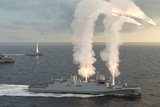
MMSC utilises the COMBATSS-21 combat management system, built from the Aegis combat system common source library, enabling anti-air and anti-surface capabilities in a small surface combatant platform.
Joe DePietro, VP, Lockheed Martin Small Combatants and Ship Systems, said: ‘The MMSC provides the Royal Saudi Naval Forces a lethal and highly manoeuvrable multi-mission surface combatant, which features the flexibility of the Freedom-variant Littoral Combat Ship steel mono-hull with expanded capabilities that include an integrated Mk41 Vertical Launch System, an increased range of 5,000 nautical miles and speeds in excess of 30kt, making it capable of littoral and open ocean operation and able to confront modern maritime and economic security threats.’
In March 2018, Lockheed Martin was awarded $481 million for long lead material for MMSC.

You may also like

More from Naval Warfare
-
![How France’s SNLE 3G programme is reshaping the naval nuclear industrial base]()
How France’s SNLE 3G programme is reshaping the naval nuclear industrial base
Extending far beyond a four-submarine replacement programme, France’s ballistic missile submarine effort is a decades-long industrial effort designed to preserve the country’s ability to build and sustain nuclear-powered strategic platforms.
-
![China’s mineral processing dominance exposes naval supply chain vulnerabilities]()
China’s mineral processing dominance exposes naval supply chain vulnerabilities
Competition for critical minerals, and China’s dominance of their processing, is emerging as a decisive factor in future naval procurement programmes.
-
![Suppliers await next step in Australia’s mine warfare transition]()
Suppliers await next step in Australia’s mine warfare transition
Australia’s mine countermeasure capability remains in flux as the Huon-class nears retirement, but accelerated investment in autonomous systems is opening a path for industry.
-
![Can the US Navy ask Indo-Pacific allies to do more while training with them less?]()
Can the US Navy ask Indo-Pacific allies to do more while training with them less?
As the Iran War draws US ships and marine corps units away from the Indo-Pacific, curtailed exercises and a temporary carrier gap are exposing tensions between Washington’s demand for more self-reliant allies and the joint training needed to realise that ambition.
-
![How could Rheinmetall’s GMF 140 fit with ongoing programmes in North America?]()
How could Rheinmetall’s GMF 140 fit with ongoing programmes in North America?
With Canada committed to its River-class replacement and the USN pursuing a lower-cost frigate, Rheinmetall will need to demonstrate where the GMF 140 can fill a capability gap in the North American fleet.