Keel laid for first Belgian-Dutch rMCM minehunter
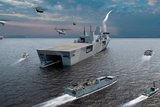
A rendering of the future rMCM programme ships and associated drones. (Image: Naval Group)
The first ship of six for Belgium will be named BNS Ostende.


On 30 November, Naval Group laid the keel for the first of 12 mine countermeasure vessels (MCMVs) under the Belgian-Dutch rMCM programme. A Naval Group-Piriou joint venture, Kership, will produce the ships in Concarneau, France.
Delivery of the first example is scheduled for the end of 2024, with the remainder staggered until 2030. Piriou will arm the ships when afloat, with Naval Group responsible for design, integration, testing and commissioning the mission system.
The contract for the programme, awarded to Naval Group/ECA Group consortium Belgium Naval & Robotics in 2019, covers supply of the ships and around 100 drones to equip a toolbox on the vessels. ECA Group will produce the drones in Ostend, Belgium.
The MCMVs will utilise a fully robotic system for the detection, classification and neutralisation of undersea mines.
Shephard Defence Insight estimates the programme cost for rMCM to be €966 million for the Netherlands and €887 million for Belgium. Both nations will receive six vessels.
Related Programmes in Defence Insight
Tripartite Class Replacement Programme [Netherlands]
Tripartite Class Replacement Programme (1-6) [Belgium]
Related Equipment in Defence Insight

You may also like
More from Naval Warfare
-
![Asia-Pacific emerges as the largest export market for US-made USVs]()
Asia-Pacific emerges as the largest export market for US-made USVs
Asian customers have placed one of the largest known international purchases of US-built uncrewed surface vessels, highlighting accelerating regional demand for autonomous maritime capabilities and distributed naval operations.
-
![RTX confirms US Marine Corps and US Navy acquire Hadalus UUV]()
RTX confirms US Marine Corps and US Navy acquire Hadalus UUV
RTX told Shephard that the Hadalus UUV has been procured by the US Marine Corps and the Office of Naval Research for operational experimentation as the company prepares additional demonstrations with the US Navy, NATO and AUKUS partners.
-
![The UK joins the movement towards joint procurement]()
The UK joins the movement towards joint procurement
The UK will spend an estimated US$3.89 billion over the next decade in joint naval programmes, a lot of which will be in cooperation with Norway.
-
![Rheinmetall’s GMF 140: Ambitious frigate or market misfit?]()
Rheinmetall’s GMF 140: Ambitious frigate or market misfit?
Rheinmetall has unveiled its first next-generation frigate design, showing ambitions to compete as a surface combatant prime contractor. While the company is targeting North America, analysts believe the concept may be better positioned for future European programmes.
-
![US Navy $76.6bn award provides stability for submarine production]()
US Navy $76.6bn award provides stability for submarine production
The US Department of War’s US$76.6 billion Columbia-and Virginia-class submarine contract gives industry demand certainty as Washington seeks to rebuild its shipbuilding base.