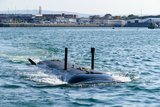
JFD and US Navy introduce Shadow NAV


JFD has partnered with the US Navy’s Naval Surface Warfare Centre – Panama City Division (NSWC PCD) to develop an advanced hands-free combat diver navigation module called the Shadow NAV.
Military combat divers often conduct underwater missions in hazardous and zero visibility conditions. Critical to mission success is having accurate underwater compass and depth readings to assist with navigation while
staying within closed circuit oxygen rebreather depth limits to prevent oxygen toxicity, which can cause significant health risks to the diver. Current handheld or tactical swim board mounted compasses, depth gauges, and chronometers are obsolete in a zero-visibility environment.
The Shadow NAV is fitted to a diver’s standard half mask and provides a clear visual display of the wearer’s compass heading, depth, and time even in near-zero visibility conditions. Through using a mask-mounted head-up display, combat divers are not restricted by the poor visibility mission environment and may not need to carry a tactical swim board.
JFD expects that the small, low-power enhanced navigation capability will significantly improve safety standards for military divers.

You may also like
More from Naval Warfare
-
![Denmark’s air defence frigate requirement draws growing European competition]()
Denmark’s air defence frigate requirement draws growing European competition
With no formal competition under way, industrial partnerships, production capacity and air defence capability could all shape the programme as Denmark considers how to replace its three Iver Huitfeldt-class frigates.
-
![Five years on: where could opportunities emerge next for AUKUS Pillar II?]()
Five years on: where could opportunities emerge next for AUKUS Pillar II?
Payload commonality, combat systems and electronic warfare are emerging as likely priorities as the trilateral partnership balances building submarines with sharing industrial ecosystems.
-
![Singapore expands maritime presence with future-ready Sentinel OPV]()
Singapore expands maritime presence with future-ready Sentinel OPV
Singapore is building space for uncrewed systems and future technologies into its new Sentinel-class OPVs, reflecting a wider move towards adaptable vessels capable of maintaining persistent maritime presence.
-
![From the Baltic to the Gulf: where USV procurement is heading next]()
From the Baltic to the Gulf: where USV procurement is heading next
Saildrone’s new Copenhagen base is one sign of a larger shift, as navies globally turn to uncrewed vessels for surveillance and mine clearance.
-
![Israeli Navy looks to expand as war reshapes future force requirements]()
Israeli Navy looks to expand as war reshapes future force requirements
Israel’s navy is preparing for a larger and more technically diverse role, but its ambitions could be impacted by supply chain restrictions, accelerating demand for domestic naval production as well as autonomous maritime capabilities.
-
![Quantum sensing gathers pace as navies eye undersea advantage]()
Quantum sensing gathers pace as navies eye undersea advantage
As AI dominates defence conversations, industry increasingly points to quantum sensing as the technology set to change submarine and uncrewed underwater vehicle operations.