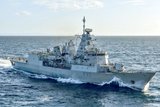
Iran leader calls for boosting of naval forces
Iran’s supreme leader Ayatollah Ali Khamenei called 28 November for the country to boost its naval forces as a deterrent against its enemies and hailed the deployment of new ships.
‘Increase your capabilities and readiness as much as you can so that the enemies of Iran will not dare threaten this great nation,’ Khamenei said in a meeting with Iran’s naval chiefs, quoted on his official website.
The Islamic republic was confronted by ‘a vast lineup of enemies and rivals’, he said.
Khamenei, quoted in English on his Twitter account, stressed that Iran ‘has no intention of launching a war against anyone’.
But the country ‘should increase our aptitudes so that enemies will fear attacking Iran and threats against Iranian nation will perish’.
He welcomed the commissioning this week of a destroyer and two submarines, all three manufactured in Iran, as signs of ‘ever increasing progress’.
Defence Minister Amir Hatami, quoted by the official news agency IRNA, said two Ghadir-class submarines are to enter service on 29 November and a new destroyer two days later.
Iran considers itself the historic guardian of the Gulf and regularly condemns the US deployment of naval and air forces in the strategic waterway.



More from Naval Warfare
-
![Russia’s uncrewed boat portfolio hints at future naval demand]()
Russia’s uncrewed boat portfolio hints at future naval demand
Ukrainian intelligence has catalogued more than 20 Russian uncrewed surface vessels, revealing a portfolio weighted towards mine warfare and logistics, with implications for Western naval investment.
-
![Ukraine’s new long-range 12m autonomous vessel can deploy other drones]()
Ukraine’s new long-range 12m autonomous vessel can deploy other drones
Ukraine’s UForce unveiled the MV11 uncrewed surface vessel, designed to launch and support other naval drones at sea, fuelling debate over the future of autonomous maritime task groups.
-
![Global submarine suppliers compete for a rapidly shrinking market]()
Global submarine suppliers compete for a rapidly shrinking market
Diminishing submarine competitions worldwide are leaving fewer acquisition opportunities, pushing contractors toward alternatives.
-
![Melting ice is rewriting Arctic naval requirements]()
Melting ice is rewriting Arctic naval requirements
As the High North opens to shipping, navies face rising demand for icebreakers, ASW vessels, uncrewed systems and surveillance assets far beyond the submarine fleet.
-
![Future frigate programme highlights broader RNZN replacement challenge]()
Future frigate programme highlights broader RNZN replacement challenge
New Zealand’s evaluation of the Mogami and Arrowhead 140 frigate designs reflects a wider push for alliance interoperability, and points to a larger recapitalisation of the Royal New Zealand Navy fleet beyond the current programme.