German Navy christens eighth K130 corvette
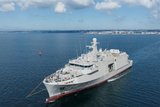
Design concept image of a K130 Batch 2 corvette for the German Navy. (Photo: German Armed Forces)
Pending the arrival of the final sternship and foredeck sections and completion of the final equipment phase, the Braunschweig-class corvette Köln will enter service with the German Navy.


The first ship in the second batch of five Braunschweig-class (K130) corvettes for the German Navy was officially named Köln in a 21 April ceremony at the Blohm+Voss shipyard in Hamburg.
Köln was laid down in April 2019. Pending the arrival of the final sternship and foredeck sections and completion of the final equipment phase, the 89m-long vessel will ‘undergo all necessary functional tests and acceptances in coordination with the specialist departments of the contracting authority and the German Navy’, Blohm+Voss noted in a statement.
Five new K130 vessels (ships six to ten in the Braunschweig class) are being built under a September 2017 contract at multiple German shipyards by an industry team led by NVL Group (formerly Lürssen Defence).
The seventh and eighth Braunschweig-class corvette (the future Emden and Karlsruhe) are at different phases in the final equipment phase, and the future Augsburg is in production.
The tenth (as-yet-unnamed) K130 vessel was laid down in early 2022.
According to Shephard Defence Insight, all five ships will be delivered to the German Navy by 2025. Each of the second batch of vessels costs about $500 million, displaces 1,800t and can reach a top speed of 26kt.
Related Programmes in Defence Insight
K130 Corvettes Batch 2 (6-10) [Germany]
Related Equipment in Defence Insight


More from Naval Warfare
-
![Babcock onshores 85% of Canada’s submarine supply chain as it eyes future CPSP programme]()
Babcock onshores 85% of Canada’s submarine supply chain as it eyes future CPSP programme
By moving most of the Royal Canadian Navy’s submarine supply chain into Canada, Babcock Canada is driving to strengthen sovereign sustainment capabilities while preparing to compete to maintain the future Canadian Patrol Submarine Project.
-
![From the seas to the web: the changing shape of UK defence in Southeast Asia]()
From the seas to the web: the changing shape of UK defence in Southeast Asia
As his final engagement before leaving his post as the head of the British defence staff for Southeast Asia and defence adviser to Singapore, Brigadier Eddie Maskell-Pedersen spoke with Shephard about maritime security, cyber cooperation and long-term partnerships.
-
![Baltic naval priorities shift towards mine warfare and versatile platforms]()
Baltic naval priorities shift towards mine warfare and versatile platforms
Baltic states are investing in mine warfare, uncrewed systems and multirole platforms as major warship purchases remain scarce, industry sources indicate.
-
![India’s mine countermeasure drive triggers rush of new partnerships]()
India’s mine countermeasure drive triggers rush of new partnerships
Parallel procurement pathways for crewed mine countermeasure vessels and uncrewed systems underline a shift towards next-generation mine warfare for the Indian Navy.