German-Filippino defence collaboration agreement edges closer in South China Sea
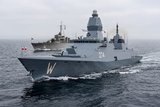
Warships on exercises in the South China Sea. (Photo: US Navy)
The countries have agreed to have a collaboration plan in place by the end of 2024.


Germany and the Philippines have agreed to speed up plans to set up a defence collaboration agreement before the end of 2024.
The two nations were already keen to set up such an agreement, but while Russia’s war in Ukraine continues, and Gaza dominates headlines worldwide, Germany and the Philippines are concerned with Chinese militarism in the South China Sea.
The South China Sea is a vital trade route for much of the world and includes areas claimed as exclusive economic zones by Vietnam, the Philippines, Malaysia, Brunei and Indonesia.
China believes almost the entire South China Sea is the sovereign possession of China.
In 2016, the Permanent Court of Arbitration in the Hague said China’s claims to exclusive possession of the South China Sea had no basis in international law, based on application of the United Nations Convention on the Law of the Sea (UNCLOS).
China, home to the second largest economy in the world and the largest army, disagrees. It also has a history of being unmoved by the opinions of the rest of the world over what it does and does not own.
The South China Sea is extremely important in the world marketplace: US$3.4 trillion of the world’s $16 trillion maritime shipping travels via the sea. It acts as a major trade conduit, carrying around 5% of the world’s GDP.
The Philippines has long had concerns about Chinese claims in the South China Sea. It began the 2016 arbitration which saw the sea declared as officially not a sovereign possession of China. In 2020, the Philippines also expressed its concern about 220 Chinese military vessels scattered around the South China Sea.
And while the world’s attention has been on larger conflicts in recent months, China and the Philippines have been trading accusations and insults about one another’s actions in the area. In particular, Manila has accused Chinese military forces of intentionally and illegally ramming Filipino naval vessels during a resupply mission to the Second Thomas Shoal. China does not dispute the fact of the ramming but insists its actions were lawful.
Such elevations of tension in the South China Sea have spurred Germany and the Philippines to accelerate the timeline of their defence agreement. While the precise details of the agreement have yet to be hammered out, both countries assert that the deal will facilitate joint military training and possible sale of German weapons to the Philippines to address counter-security challenges.
That language has been bolstered by a recent US commitment of $500 million to modernise the Filipino army. The US has previously run naval exercises in the South China Sea. The modernisation money, allied to the German-Filipino defence agreement, suggests a growing union of Western and Southeast Asian governments preparing their military readiness in the region.
Related Programmes in Defence Insight
Naval: Combat Management Systems | Multi-Role Response Vessels [Philippines]


More from Naval Warfare
-
![Canada assesses security equipment changes for Polar Icebreaker Imnaryuaq]()
Canada assesses security equipment changes for Polar Icebreaker Imnaryuaq
The Canadian Department of National Defence is evaluating communications and reconnaissance changes for CCGS Imnaryuaq’s expanded maritime security role, while retaining its 2032 acceptance target.
-
![US Navy’s MQ-25 Stingray approaches carrier-integration tests]()
US Navy’s MQ-25 Stingray approaches carrier-integration tests
Boeing has outlined its upcoming precision-landing and carrier-airspace trials as MQ-25 manufacturing shifts towards Illinois, with initial Lot 1 deliveries expected in 2029.
-
![From Poland to the Pacific: can Miecznik become a blueprint for other navies?]()
From Poland to the Pacific: can Miecznik become a blueprint for other navies?
Babcock is taking its Polish industrial partnership approach to Denmark and New Zealand as navies seek sovereign shipbuilding skills alongside ships.
-
![Unsettled waters in the North: can navies still trust their Arctic acoustic maps?]()
Unsettled waters in the North: can navies still trust their Arctic acoustic maps?
The changing Arctic environment is creating new challenges for submarine detection, driving demand for distributed sensors, uncrewed underwater vehicles and real-time acoustic modelling.