FREMM Provence begins sea trial programme


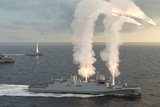
Sea trials for the French Navy’s FREMM Provence are underway with the vessel completing its first sea outing on 1 October and trials set to continue off the Brittany coast over the coming weeks.
FREMM Provence is the third of the series of vessels ordered by OCCAR on behalf of the DGA and the French Navy. DCNS will build 12 vessels in total under the FREMM programme; 11 for the French Navy and one for the Royal Moroccan Navy.
During FREMM Provence’s sea outing, DCNS tested the performance of the vessel’s propulsion and navigation systems. The vessel will now commence a series of sea trials, including the ‘appropriation’ phase that will see the team verify the proper functioning of all the safety installations and systems, such as the fire-fighting and anti-flooding systems, vessel evacuation, maneuverability or mooring performance.
The second phase of trials will assess the vessel’s propulsion system, in particular the CODLOG (COmbined Diesel eLectric Or Gas) hybrid system, which allows the FREMM to sail silently at low speed – thanks to the electric motors – or to reach speeds in excess of 27 knots thanks to the vessels gas turbine. In addition to the propulsion trials, the DCNS teams will perform verifications of the navigation systems.
Anne Bianchi, FREMM program director, said: ‘The completion of this industrial milestone is the fruit of the remarkable collective effort of the DCNS teams and those of its partners and suppliers as well as the operating crew of the French Navy and the representatives of the DGA and OCCAR. The realisation of this third FREMM for the French Navy is proceeding in accordance with the schedule and budget. These vessels are the most technologically advanced and competitive on the market.’
Following the completion of the initial trials the frigate will return to quay on the DCNS site in Lorient before beginning a new campaign of trials at the start of 2015, this time focused on the combat system.

You may also like


More from Naval Warfare
-
![How could Rheinmetall’s GMF 140 fit with ongoing programmes in North America?]()
How could Rheinmetall’s GMF 140 fit with ongoing programmes in North America?
With Canada committed to its River-class replacement and the USN pursuing a lower-cost frigate, Rheinmetall will need to demonstrate where the GMF 140 can fill a capability gap in the North American fleet.
-
![Australian industry programme builds pipeline for Virginia-class sustainment]()
Australian industry programme builds pipeline for Virginia-class sustainment
Australian businesses can now bid to support Virginia-class submarine sustainment in Western Australia, as momentum around the Henderson Defence Precinct also builds.
-
![South Korea, Japan and Turkey vie for US shipbuilding access in future frigate contest]()
South Korea, Japan and Turkey vie for US shipbuilding access in future frigate contest
Washington’s search for a foreign-built frigate could hand South Korea, Japan and Turkey a larger prize than a double-hull order: a foothold inside the US shipbuilding industrial base.
-
![Russia’s uncrewed boat portfolio hints at future naval demand]()
Russia’s uncrewed boat portfolio hints at future naval demand
Ukrainian intelligence has catalogued more than 20 Russian uncrewed surface vessels, revealing a portfolio weighted towards mine warfare and logistics, with implications for Western naval investment.
-
![Ukraine’s new long-range 12m autonomous vessel can deploy other drones]()
Ukraine’s new long-range 12m autonomous vessel can deploy other drones
Ukraine’s UForce unveiled the MV11 uncrewed surface vessel, designed to launch and support other naval drones at sea, fuelling debate over the future of autonomous maritime task groups.