French Navy’s Normandie frigate continues sea trials


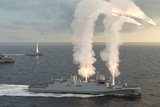
The second frigate of the French Navy’s FREMM programme, Normandie, has completed its third series of sea trials off the Brittany coast. The vessel returned to port at the DCNS site in Lorient on 8 March.
The trials, which lasted one week, were conducted to allow DCNS teams and French Navy crew to verify the vessel’s performance; and test the performance of various combat-system sensors and the Syracuse communication station.
Tests were conducted on the propulsion system and, in particular, on the CODLOG (COmbined Diesel eLectric Or Gas) hybrid system. This propulsion system allows the FREMMs to advance silently at low speed – thanks to the electric motors – or reach speeds in excess of 27 knots thanks to the vessel’s gas turbine. In addition to these propulsion tests, the DCNS teams also verified the navigation systems (speed calculations, position, bearing) as well as the inertial units, which allow a very precise positioning of the vessel whatever its location on the oceans.
These trials followed initial phases of testing in November 2012 and January 2013. During the January phase, the frigate made its first stopover in Brest, which allowed the verification of the proper operation of the interfaces between the frigate and the port installations with regard to shore communications, docking and utility connections.
Normandie is the second of the series ordered by the French DGA (General Directorate for Armament) for the French Navy. The FREMM programme will see eleven frigates in total built for France, and one for the Royal Moroccan Navy.
DCNS said the vessel will sail again in the coming weeks for further trials, ahead of delivery to the French Navy later this year.

You may also like
More from Naval Warfare
-
![Suppliers await next step in Australia’s mine warfare transition]()
Suppliers await next step in Australia’s mine warfare transition
Australia’s mine countermeasure capability remains in flux as the Huon-class nears retirement, but accelerated investment in autonomous systems is opening a path for industry.
-
![Can the US Navy ask Indo-Pacific allies to do more while training with them less?]()
Can the US Navy ask Indo-Pacific allies to do more while training with them less?
As the Iran War draws US ships and marine corps units away from the Indo-Pacific, curtailed exercises and a temporary carrier gap are exposing tensions between Washington’s demand for more self-reliant allies and the joint training needed to realise that ambition.
-
![How could Rheinmetall’s GMF 140 fit with ongoing programmes in North America?]()
How could Rheinmetall’s GMF 140 fit with ongoing programmes in North America?
With Canada committed to its River-class replacement and the USN pursuing a lower-cost frigate, Rheinmetall will need to demonstrate where the GMF 140 can fill a capability gap in the North American fleet.
-
![Australian industry programme builds pipeline for Virginia-class sustainment]()
Australian industry programme builds pipeline for Virginia-class sustainment
Australian businesses can now bid to support Virginia-class submarine sustainment in Western Australia, as momentum around the Henderson Defence Precinct also builds.
-
![South Korea, Japan and Turkey vie for US shipbuilding access in future frigate contest]()
South Korea, Japan and Turkey vie for US shipbuilding access in future frigate contest
Washington’s search for a foreign-built frigate could hand South Korea, Japan and Turkey a larger prize than a double-hull order: a foothold inside the US shipbuilding industrial base.