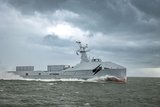
Turkey’s Goksur naval missile completes first live-fire intercept
The test firing saw a target destroyed over the Black Sea. (Photo: Aselsan)
The Goksur will be available in a range of configurations and could be integrated into Turkey’s nascent Steel Dome which is designed to provide multi-layered protection against a range of aerial targets from mortars to aircraft.


Turkey’s Aselsan has announced the first live fire and intercept of a target using the Goksur air defence system in a demonstration of sea-skimming capability.
The test took place in Sinop, in the northern Black Sea region of Turkey, where the Goksur imaging infrared (IIR) missile hit a sea-skimming target at a range of more than 11km.
The firing was conducted from Aselsan’s Goksur 100-N vertical launch system (VLS) with the missile guided via the company’s Gudu data link during its mid-course phase and autonomously locked onto its target in the terminal phase. According to the company, it was a “direct hit
Our news & analysis is now part of Defence Insight®
A Basic-level or higher Defence Insight subscription is now required to view this content.

More from Naval Warfare
-
![US Navy’s MQ-25 Stingray approaches carrier-integration tests]()
US Navy’s MQ-25 Stingray approaches carrier-integration tests
Boeing has outlined its upcoming precision-landing and carrier-airspace trials as MQ-25 manufacturing shifts towards Illinois, with initial Lot 1 deliveries expected in 2029.
-
![From Poland to the Pacific: Can Miecznik become a blueprint for other navies?]()
From Poland to the Pacific: Can Miecznik become a blueprint for other navies?
Babcock is taking its Polish industrial partnership approach to Denmark and New Zealand as navies seek sovereign shipbuilding skills alongside ships.
-
![Unsettled waters in the North: can navies still trust their Arctic acoustic maps?]()
Unsettled waters in the North: can navies still trust their Arctic acoustic maps?
The changing Arctic environment is creating new challenges for submarine detection, driving demand for distributed sensors, uncrewed underwater vehicles and real-time acoustic modelling.
-
![Aevex, Lockheed Martin and Thales deals highlight consolidation in naval technology]()
Aevex, Lockheed Martin and Thales deals highlight consolidation in naval technology
A wave of acquisitions is bringing specialist autonomy and underwater technology under the umbrella of larger defence contractors. As a result, navies may gain faster access to capability, but not necessarily a broader choice of suppliers.
-
![Italy’s DDX destroyer deal opens a decade of naval spending]()
Italy’s DDX destroyer deal opens a decade of naval spending
A €3.7 billion destroyer contract for Fincantieri and Leonardo is only the start, with submarines, corvettes and a new carrier pointing to more opportunities.
-
![Production-ready beats prototype-ready in the US Navy’s MUSV marketplace]()
Production-ready beats prototype-ready in the US Navy’s MUSV marketplace
HII, Saronic and Galliano Marine Services have won US Navy production contracts to supply medium uncrewed surface vessels. The marketplace approach behind them sets the bar for suppliers eyeing allied navy competitions.