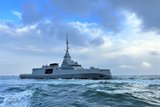
First F125 frigate commissioned
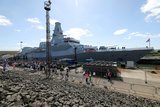
The first F125 Baden-Württemberg frigate built by ARGE F125 and Thyssenkrupp Marine Systems was commissioned for the German Navy on 17 June.
The newly designed class F125 ships have highly complex systems and approximately 28,000 sensors. With a very high degree of automation and the ability to remain in their operational area for up to two years, it has been possible to halve the crew size in comparison to previous German frigate classes.
The vessels are designed to carry out maritime defence operations, as well as conflict prevention, crisis management and intervention, and stabilisation operations. They can defend against offshore and onshore attacks, and are equipped with anti-aircraft systems and helicopters specially equipped for submarine hunting.
The second class F125 ship, the Nordrhein-Westfalen will also be handed over the to navy this year. The third and fourth ships will follow over the coming two years.
The ARGE F125 consortium comprises Thyssenkrupp Marine Systems as the lead company and Fr Lürssen Werft in Bremen. The pre-fitted bow sections are being manufactured at the shipyards of the Lürssen Group in Bremen and Wolgast. Construction of the stern sections, the joining of the two sections and further fitting out was being carried out at Blohm+Voss Shipyards in Hamburg under the leadership of Thyssenkrupp Marine Systems.



More from Naval Warfare
-
![Kraken’s Royal Navy USV contract signals next step in crewed-uncrewed integration]()
Kraken’s Royal Navy USV contract signals next step in crewed-uncrewed integration
The UK Royal Navy’s rapid procurement of uncrewed platforms aligns with the force’s strategic shift towards a fleet better equipped to handle modern threats.
-
![HMS Anson’s milestone stay in Australia cut short during AUKUS deployment]()
HMS Anson’s milestone stay in Australia cut short during AUKUS deployment
The Astute-class submarine’s visit to Australia was the first time maintenance activity on a UK Royal Navy nuclear submarine had been carried out in the country.
-
![How Operation Epic Fury could reduce US readiness to face China]()
How Operation Epic Fury could reduce US readiness to face China
The offensive against Iran could impact training and maintenance cycles and accelerate the degradation of the US arsenal on top of depleting Washington’s stockpiles.
-
![UK Royal Navy explores modular counter-drone capabilities for future hybrid fleet]()
UK Royal Navy explores modular counter-drone capabilities for future hybrid fleet
The UK MoD is scoping out systems to counter the growing threat of uncrewed aerial systems, with a focus on low-cost modularity and speed to field.
-
![US Pentagon claims to have severely damaged Iranian capabilities, promises to increase attacks]()
US Pentagon claims to have severely damaged Iranian capabilities, promises to increase attacks
US military authorities claim to have sunk 20 Iranian vessels and destroyed Tehran’s Air Force, with the Pentagon making plans to send additional assets to the region.
-
![Greece’s newly commissioned FDI frigate deployed to Cyprus]()
Greece’s newly commissioned FDI frigate deployed to Cyprus
The recent naval modernisation efforts by the Hellenic Navy have been bolstered by the acquisition of advanced Naval Group frigates, the first of which was delivered in December 2025 and is now playing a crucial role in the latest Middle East conflict.