First Defiant-class NCPV enters service in Dominican Republic


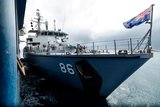
The Navy of the Dominican Republic (Armada de Republica Dominicana - ARD) has received a new coastal patrol craft built by Metal Shark.
The vessel is now in service with the ARD as Betelgeuse after a commissioning ceremony on 21 August. It is the first of 13 Defiant-class near coastal patrol vessels (NCPVs) being produced by Metal Shark under a $54 million FMS contract from the USN to support Caribbean and Central American allies.
Other NCPV operators besides the Dominican Republic will include Costa Rica, El Salvador, Guatemala and Honduras.
The monohull NCPV design is based on the 2606 Standardized Patrol Vessel from Damen Shipyards.
Powered by two 1,600hp Caterpillar C-32 marine diesel engines turning fixed-pitch Michigan Wheel propellers through Twin Disc MGX-6599 transmissions, the NCPV is designed for missions of up to six days at sea in near-shore ocean conditions, supporting an operating crew of ten. It also carries a 5.6m-long aluminium RIB.
The vessel is designed to support a wide range of missions including SAR, border patrol, police and customs duties, counter-narcotics operations and EEZ patrol.
As noted by Shephard Defence Insight, the Metal Shark Defiant design has also been selected as a replacement for the fleet of force protection boats currently in use with the USN Expeditionary Combat Command’s Coastal Riverine Forces (CRF).
Subject to annual appropriations, the USN intends to replace approximately 100 to 160 of its existing 25ft (7.62m) and 34ft CRF patrol boats with the larger and more modern PB(X) platform over the next 15 years.
As part of our promise to deliver comprehensive coverage to our Defence Insight and Premium News subscribers, our curated defence news content provides the latest industry updates, contract awards and programme milestones.
Related Programmes in Defence Insight
Related Equipment in Defence Insight



More from Naval Warfare
-
![Competitive P17B tender marks a shift in Indian Navy frigate procurement]()
Competitive P17B tender marks a shift in Indian Navy frigate procurement
The Indian Navy's P17B programme is expected to combine greater weapons capacity with a competitive domestic construction model, although key systems could remain dependent on international supply chains.
-
![How France’s SNLE 3G programme is reshaping the naval nuclear industrial base]()
How France’s SNLE 3G programme is reshaping the naval nuclear industrial base
Extending far beyond a four-submarine replacement programme, France’s ballistic missile submarine effort is a decades-long industrial initiative designed to preserve the country’s ability to build and sustain nuclear-powered strategic platforms.
-
![Quantum Systems enters maritime domain with Baltic-focused USV and UUV]()
Quantum Systems enters maritime domain with Baltic-focused USV and UUV
Quantum Systems has launched into the maritime domain with Seavex and Subvex, aiming to close a Baltic Sea ISR gap opened by infrastructure sabotage.
-
![Suppliers await next step in Australia’s mine warfare transition]()
Suppliers await next step in Australia’s mine warfare transition
Australia’s mine countermeasure capability remains in flux as the Huon-class nears retirement, but accelerated investment in autonomous systems is opening a path for industry.
-
![Can the US Navy ask Indo-Pacific allies to do more while training with them less?]()
Can the US Navy ask Indo-Pacific allies to do more while training with them less?
As the Iran War draws US ships and marine corps units away from the Indo-Pacific, curtailed exercises and a temporary carrier gap are exposing tensions between Washington’s demand for more self-reliant allies and the joint training needed to realise that ambition.