Fincantieri to build second Logistics Support Ship for the Italian Navy
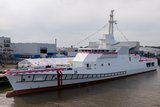
Logistic Support Ship Vulcano. (Photo: Fincantieri)
The Italian Navy’s first Logistic Support Ship, Vulcano, was delivered in March; Fincantieri has just been contracted to build a second vessel.


The Organisation for Joint Armament Cooperation (OCCAR) has awarded a Fincantieri-led consortium a contract to construct a second Logistic Support Ship (LSS) for the Italian Navy.
The contract worth €410 million ($463 million), including the combat management system, will see the ship entirely built and delivered at the Castellammare di Stabia shipyard.
Delivery of the second LSS is scheduled for 2025, and the programme includes an option for a third ship.
The design has also been modified to meet French Navy requirements, with Paris ordering four Bâtiments Ravitailleurs de Force (BRF) ships under its Flotte Logistique programme.
The Italian LSS can carry liquid and solid stores and features an 800m2 hospital facility consisting of two operating rooms, a radiology room, emergency rooms and other facilities.
The vessel measures 193m long and can reach up to 20kts.
Related Programmes in Defence Insight
Logistic Support Ship (2) [Italy]
Italian Logistics Support Ships (LSS)
Related Equipment in Defence Insight



More from Naval Warfare
-
![Argentina’s submarine and frigate acquisitions resurface with $3.5bn funding plan]()
Argentina’s submarine and frigate acquisitions resurface with $3.5bn funding plan
Buenos Aires set out foreign loans worth $3.5 billion in its draft 2027 budget, opening a contest in which Naval Group and TKMS could lead the field.
-
![Five years on: where could opportunities emerge next for AUKUS Pillar II?]()
Five years on: where could opportunities emerge next for AUKUS Pillar II?
Payload commonality, combat systems and electronic warfare are emerging as likely priorities as the trilateral partnership balances building submarines with sharing industrial ecosystems.
-
![Singapore expands maritime presence with future-ready Sentinel OPV]()
Singapore expands maritime presence with future-ready Sentinel OPV
Singapore is building space for uncrewed systems and future technologies into its new Sentinel-class OPVs, reflecting a wider move towards adaptable vessels capable of maintaining persistent maritime presence.