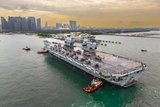
Final French FREMM frigate’s first sea trials begin
Lorraine is the eighth and final FREMM frigate for the French Navy. (Photo: Naval Group)
Lorraine will be the French Navy’s eighth FREMM frigate and second with enhanced air defence capabilities.


On 22 February, Naval Group began sea trials of France’s final FREMM frigate Lorraine.
Over several days, the air defence FREMM frigate will undergo trials off the coast of Brittany, France, ahead of its planned delivery before the end of 2022.
Lorraine is the second of two FREMM frigates for the French Navy equipped with enhanced air defence capabilities. The other, Alsace, was declared ready for operations in November 2021.
The air defence FREMM ships can carry 8 Exocet MM40 Block 3 anti-ship missiles and 32 Aster missiles in Sylver vertical launch systems.
Naval Group said that due to operational feedback on the FREMM class, Lorraine would benefit from enhanced cyber capabilities, Link 22 secure digital data link communications and a reduced-width mast, among other alterations.
Related Programmes in Defence Insight
Frégate Européen multi-missions (FREMM) - Aquitaine Class
Related Equipment in Defence Insight

You may also like

More from Naval Warfare
-
![US Navy begins SPY-6(V)4 radar testing ahead of first Arleigh Burke destroyer backfit]()
US Navy begins SPY-6(V)4 radar testing ahead of first Arleigh Burke destroyer backfit
Wallops Island trials will validate the next-generation radar's combat system integration before its installation aboard USS Pinckney, the first Flight IIA destroyer to receive the SPY-6(V)4 upgrade.
-
![Hanwha Ocean deepens US ties and eyes Saudi submarine prospect after Canada setback]()
Hanwha Ocean deepens US ties and eyes Saudi submarine prospect after Canada setback
Hanwha Ocean is deepening ties with the US and eyeing a submarine opportunity in Saudi Arabia, as South Korea looks to convert its Canadian defeat into export momentum.
-
![A400M trial demonstrates airborne deployment of uncrewed surface vessel]()
A400M trial demonstrates airborne deployment of uncrewed surface vessel
Kraken Technology Group’s A400M airdrop of a K3 Scout uncrewed surface vessel points to a new way for navies to insert USVs into contested waters, bypassing ports and motherships.
-
![Babcock onshores 85% of Canada’s submarine supply chain as it eyes future CPSP programme]()
Babcock onshores 85% of Canada’s submarine supply chain as it eyes future CPSP programme
By moving most of the Royal Canadian Navy’s submarine supply chain into Canada, Babcock Canada is driving to strengthen sovereign sustainment capabilities while preparing to compete to maintain the future Canadian Patrol Submarine Project.
-
![From the seas to the web: the changing shape of UK defence in Southeast Asia]()
From the seas to the web: the changing shape of UK defence in Southeast Asia
As his final engagement before leaving his post as the head of the British defence staff for Southeast Asia and defence adviser to Singapore, Brigadier Eddie Maskell-Pedersen spoke with Shephard about maritime security, cyber cooperation and long-term partnerships.