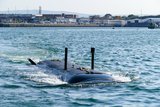
Dstl tests autonomous launch and recovery system
The X-LARS trial USV in the autonomous Launch and Recovery System (LARS) cradle. (Photo: Dstl/ Crown Copyright)
Solving launch and recovery issues is crucial to making USVs feasible operational assets.


The UK Defence Science and Technology Laboratory (Dstl) has developed and tested a concept for an autonomous launch and recovery system (LARS) that can receive USVs in a cradle.
The autonomous LARS is designed to negate the need to put human operators onto USVs to enable their launch and recovery.
Shephard understands that the goal of the development is to allow the RN to deploy and recover boats, such as USVs, with as minimal human input as possible.
Launching and recovering boats traditionally requires multiple crew members and a person onboard a vessel.
For USVs, this means sometimes launching another boat,
Our news & analysis is now part of Defence Insight®
A Basic-level or higher Defence Insight subscription is now required to view this content.




More from Naval Warfare
-
![Five years on: where could opportunities emerge next for AUKUS Pillar II?]()
Five years on: where could opportunities emerge next for AUKUS Pillar II?
Payload commonality, combat systems and electronic warfare are emerging as likely priorities as the trilateral partnership balances building submarines with sharing industrial ecosystems.
-
![Singapore expands maritime presence with future-ready Sentinel OPV]()
Singapore expands maritime presence with future-ready Sentinel OPV
Singapore is building space for uncrewed systems and future technologies into its new Sentinel-class OPVs, reflecting a wider move towards adaptable vessels capable of maintaining persistent maritime presence.
-
![From the Baltic to the Gulf: where USV procurement is heading next]()
From the Baltic to the Gulf: where USV procurement is heading next
Saildrone’s new Copenhagen base is one sign of a larger shift, as navies globally turn to uncrewed vessels for surveillance and mine clearance.
-
![Israeli Navy looks to expand as war reshapes future force requirements]()
Israeli Navy looks to expand as war reshapes future force requirements
Israel’s navy is preparing for a larger and more technically diverse role, but its ambitions could be impacted by supply chain restrictions, accelerating demand for domestic naval production as well as autonomous maritime capabilities.
-
![Quantum sensing gathers pace as navies eye undersea advantage]()
Quantum sensing gathers pace as navies eye undersea advantage
As AI dominates defence conversations, industry increasingly points to quantum sensing as the technology set to change submarine and uncrewed underwater vehicle operations.