Canada begins work on heavy polar icebreaker to protect its high-Arctic sovereignty
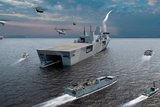
How the new icebreaker could look. (Image: Seaspan)
The vessel, made under the auspices of the country’s National Shipbuilding Strategy, will be the first heavy icebreaker built in Canada for over six decades.


Canadian shipbuilder Seaspan has begun construction of the country’s new heavy polar icebreaker vessel.
The first steel for the new Canadian Coast Guard (CCG) vessel was cut on 3 April in North Vancouver. Seaspan said the vessel, when commissioned, would be “one of the most advanced conventional polar icebreakers ever to be built”.
The Polar Class 2 vessel will be 158m long and 28m wide, and has been designed to operate self-sufficiently in the high-Arctic the whole year round.
When it becomes part of the CCG’s fleet, it will help the service work more than 162,000km of Arctic coastline.
Among
Our news & analysis is now part of Defence Insight®
A Basic-level or higher Defence Insight subscription is now required to view this content.

More from Naval Warfare
-
![Industry sees opportunity in Australia’s shift to networked undersea warfare]()
Industry sees opportunity in Australia’s shift to networked undersea warfare
Australia’s new defence innovation strategy indicates a shift from platform-centric to network-centric undersea warfare, with Ocius and Anduril Industries pointing to fast-growing opportunities for local industry.
-
![Asia-Pacific emerges as the largest export market for US-made USVs]()
Asia-Pacific emerges as the largest export market for US-made USVs
Asian customers have placed one of the largest known international purchases of US-built uncrewed surface vessels, highlighting accelerating regional demand for autonomous maritime capabilities and distributed naval operations.
-
![RTX confirms US Marine Corps and US Navy acquire Hadalus UUV]()
RTX confirms US Marine Corps and US Navy acquire Hadalus UUV
RTX told Shephard that the Hadalus UUV has been procured by the US Marine Corps and the Office of Naval Research for operational experimentation as the company prepares additional demonstrations with the US Navy, NATO and AUKUS partners.