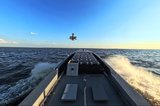
C-Worker 15 large USV displayed at Oceanology International 2024
L3Harris's new USV can carry a 10,000kg payload. (Photo: L3Harris)
L3 Harris has a list of USVs, including C-Worker 4, 5 and 6, which range in weight from 1,000kg to 4,500kg. Its latest system, C-Worker 15, weighs in at 14,500kg.


L3Harris unveiled its new C-Worker 15 large USV at the Oceanology International 2024 conference in London which will run until 14 March.
The vessel has been designed to carry a range of payload options and has a 10m x 4m aft deck, which can accommodate a 20ft intermodal container and a 10,000kg payload supplied with a baseline of 40kW of power.
A gondola mounting configurable for a wide range of sensors has been fitted to the vessel. Internally, it has space for four full-height 48cm (19in) racks for topside acquisition, processing and storage hardware in an environmentally controlled peak.
The C-Worker 15 has been designed specifically for the operation of towed sensors or ROV payloads (including fully autonomous launch and recovery), offering a low-emission solution for both military or commercial data acquisition.
The company stated the vessel has 21-day endurance, and has been optimised for towed sensor and Inspection Class ROV (Class II) operations. It was designed and built to the MCA Workboat Code as a Category 0 vessel for unrestricted service areas.
Defence applications include maritime domain awareness, ISR, insertion operations support, combat SAR, deterrence, close in force protection, swarm protection/operations and surface warfare.


More from Naval Warfare
-
![German Navy’s Israeli missile test points to deepening defence-industrial ties]()
German Navy’s Israeli missile test points to deepening defence-industrial ties
The test-firing of an Israel Aerospace Industries LORA ballistic missile from a German vessel highlights the Bundeswehr’s focus on speed to capability as it trials Israel’s operationally proven technology.
-
![Global submarine suppliers compete for a rapidly shrinking market]()
Global submarine suppliers compete for a rapidly shrinking market
Diminishing submarine competitions worldwide are leaving fewer acquisition opportunities, pushing contractors toward alternatives.
-
![Future frigate programme highlights broader RNZN replacement challenge]()
Future frigate programme highlights broader RNZN replacement challenge
New Zealand’s evaluation of the Mogami and Arrowhead 140 frigate designs reflects a wider push for alliance interoperability, and points to a larger recapitalisation of the Royal New Zealand Navy fleet beyond the current programme.