Birdon selected for new Australian medium littoral craft with plans for the heavy element to follow
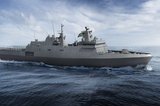
Birdon has kept quiet about its LMV-M bid over the past two years refusing to engage with the media or disclose the details of its design and industrial arrangements. (Photo: Birdon)
The Royal Australian Navy is developing a new amphibious capability that will allow it to forward position Australian Army units from shore-to-shore or ship-to-shore at long distances. This will enhance the Australian Defence Force’s (ADF’s) rapid deployment capability and ability to operate in a contested environment.


The Australian Department of Defence (DoD) has selected Birdon Group as preferred designer for Project Land 8710 Phase 1: Littoral Manoeuvre Vessel – Medium (LMV-M), which will see the construction of 18 new 60m-long ships that will replace the Army’s existing 15 Landing Craft Medium 8 (LCM 8) vessels operated by the Army’s 35th Water Transport Squadron. Deliveries will begin from 2026.
The announcement, made on 23 November, has brought the project forward by several months as a decision was not expected until 2024 following the completion of an 18-month analysis phase. It was not clear if Land 8170 phase 1 had been part
Our news & analysis is now part of Defence Insight®
A Basic-level or higher Defence Insight subscription is now required to view this content.

More from Naval Warfare
-
![Seoul’s SSN programme launch raises questions on fuel, tech and build location]()
Seoul’s SSN programme launch raises questions on fuel, tech and build location
Seoul has unveiled its “Jangbogo-N Project” to develop domestically built, nuclear-propelled attack submarines in close coordination with Washington, marking an escalation of the Republic of Korea’s deterrence posture against Pyongyang’s undersea nuclear capabilities.
-
![Subsea surveillance: why connecting military and civilian assets could be crucial]()
Subsea surveillance: why connecting military and civilian assets could be crucial
As costs rise and threats multiply, maritime awareness is shifting from platforms to networks, and civilian infrastructure plays a central role.
-
![Shoreline vulnerability drives Gulf interest in USV networks]()
Shoreline vulnerability drives Gulf interest in USV networks
Ukraine’s combat-proven Magura uncrewed surface vessel is attracting Gulf state interest as the Iran war exposes gaps in layered maritime air defence, raising questions about whether low-cost attritable systems can gain a foothold in a procurement culture historically drawn to high-end Western platforms.