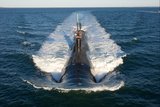
BAE Systems expands its UUV family


BAE Systems on 22 September unveiled its Riptide UUV-12 system, as the newest addition to its portfolio of unmanned undersea systems.
The 30.5cm-diameter vehicle joins three other small UUV variants and marks the entry of BAE Systems into the medium UUV market.
UUV-12 is the first new vehicle of its kind to be launched since the company bought Riptide Autonomous Solutions in 2019.
Jeff Smith, chief scientist in the FAST Labs R&D organisation within BAE Systems, said: ‘With this medium-size platform, we are strategically aligning our modular, open architecture-based UUV platform to meet rapidly expanding applications and requirements.’
UUV-12 can be customised to meet a variety of mission needs, including those that require larger and more power-hungry payloads. Integrated with mission system payloads from BAE Systems, it can deliver combinations of RF signal collection, EW, active acoustics, acoustic IFF, acoustic and RF communications, mission autonomy and navigation.
The UUV can undertake long-endurance missions, BAE Systems added, thanks to its high-efficiency electronics architecture coupled with a highly efficient, low-noise propulsion system.
As part of our promise to deliver comprehensive coverage to our Defence Insight and Premium News subscribers, our curated defence news content provides the latest industry updates, contract awards and programme milestones.


More from Naval Warfare
-
![The UK joins the movement towards joint procurement]()
The UK joins the movement towards joint procurement
The UK will spend an estimated US$3.89 billion over the next decade in joint naval programmes, a lot of which will be in cooperation with Norway.
-
![Rheinmetall’s GMF 140: Ambitious frigate or market misfit?]()
Rheinmetall’s GMF 140: Ambitious frigate or market misfit?
Rheinmetall has unveiled its first next-generation frigate design, showing ambitions to compete as a surface combatant prime contractor. While the company is targeting North America, analysts believe the concept may be better positioned for future European programmes.
-
![US Navy $76.6bn award provides stability for submarine production]()
US Navy $76.6bn award provides stability for submarine production
The US Department of War’s US$76.6 billion Columbia-and Virginia-class submarine contract gives industry demand certainty as Washington seeks to rebuild its shipbuilding base.