BAE contracted for US Navy destroyer upgrade
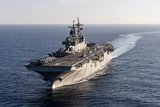
USS Lassen will dry-dock at BAE Systems' Jacksonville facility. (Photo: BAE Systems)
BAE Systems will modernise the US Navy Arleigh Burke-class destroyer USS Lassen under a new contract award.


The USN has awarded BAE Systems a contract worth up to $137 million to modernise Flight IIA Arleigh Burke-class destroyer USS Lassen (DDG-82)
The destroyer will dry-dock for seven months at BAE Systems’ Jacksonville ship repair facility.
Work will include underwater hull preservation efforts, reconditioning of engineering spaces, upgrades to C2 equipment and refurbishment of the crew’s living spaces.
Depot maintenance work will begin this month and be completed in April 2024.
Similar work at Jacksonville is currently nearing completion on another Arleigh Burke-class destroyer, USS Winston S Churchill (DDG-81).
Elsewhere, on 10 January, Northrop Grumman successfully demonstrated key components of its future Ultra-Lite Electronic Attack (EA) prototype system.
Demonstrations were held in collaboration with the US Naval Research Laboratory (NRL) aboard an Arleigh Burke-class destroyer during RIMPAC exercises.
The Ultra-Lite EA is a scaled-down EA system for anti-ship missile defence of smaller vessels.
Related Equipment in Defence Insight


More from Naval Warfare
-
![How could Rheinmetall’s GMF 140 fit with ongoing programmes in North America?]()
How could Rheinmetall’s GMF 140 fit with ongoing programmes in North America?
With Canada committed to its River-class replacement and the USN pursuing a lower-cost frigate, Rheinmetall will need to demonstrate where the GMF 140 can fill a capability gap in the North American fleet.
-
![Australian industry programme builds pipeline for Virginia-class sustainment]()
Australian industry programme builds pipeline for Virginia-class sustainment
Australian businesses can now bid to support Virginia-class submarine sustainment in Western Australia, as momentum around the Henderson Defence Precinct also builds.
-
![South Korea, Japan and Turkey vie for US shipbuilding access in future frigate contest]()
South Korea, Japan and Turkey vie for US shipbuilding access in future frigate contest
Washington’s search for a foreign-built frigate could hand South Korea, Japan and Turkey a larger prize than a double-hull order: a foothold inside the US shipbuilding industrial base.
-
![Japan’s FY2027 budget bets on stand-off systems to offset demographic decline]()
Japan’s FY2027 budget bets on stand-off systems to offset demographic decline
Japan’s FY2027 defence budget backs stand-off strike, a 17-aircraft MQ-9B buy and a declared bid to lead the world in uncrewed maritime assets, alongside new frigates, submarines and support ships.