Babcock wins new contract to support UK Royal Navy Phalanx weapon system
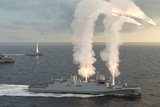
HMS Albion gunners conduct exercises with the Phalanx deck gun firing live rounds. The system will continue to be supported by Babcock. (Photo: Crown Copyright)
The Phalanx is used on multiple Royal Navy platforms, including the Albion-class landing platform dock, Royal Fleet Auxiliary, Type 45 Class destroyer and Queen Elizabeth Class aircraft carriers.


Babcock International will provide support for the UK Royal Navy’s (RN’s) Phalanx Close-In Weapon Support System (CIWS) over three years under a £18 million (US$21.8 million) contract announced on 30 October.
The weapon features a 20mm gun capable of firing armour-piercing bullets at up to 4,500 rounds per minute. It can be installed on multiple RN platforms, including the Albion-class landing platform dock, Royal Fleet Auxiliary, Daring- Class Type 45 destroyer and Queen Elizabeth Class aircraft carriers.
Babcock has been supporting the system since 2006 and the new contract will cover up to 41 systems, including nine overhauls and upgrades. It will also be responsible for logistics management, obsolescence management, availability and reliability of the Phalanx.
In December 2014, Babcock was awarded a contract by the UK MoD to deliver four Phalanx 1B kits and convert four land Phalanx Weapons Systems to their original maritime configuration. Three of the four new systems were purchased to provide defensive capability to HMS Queen Elizabeth aircraft carrier.
In September 2018, the US State Department approved a potential foreign military sale of MK 15 Phalanx upgrade kits to the UK. In a package worth $75 million, the UK had requested 50 MK 15 Block IB Baseline 2 upgrade kits.
In 2021 Babcock was awarded a two-year £15 million to support the weapons.

You may also like

More from Naval Warfare
-
![Suppliers await next step in Australia’s mine warfare transition]()
Suppliers await next step in Australia’s mine warfare transition
Australia’s mine countermeasure capability remains in flux as the Huon-class nears retirement, but accelerated investment in autonomous systems is opening a path for industry.
-
![Can the US Navy ask Indo-Pacific allies to do more while training with them less?]()
Can the US Navy ask Indo-Pacific allies to do more while training with them less?
As the Iran War draws US ships and marine corps units away from the Indo-Pacific, curtailed exercises and a temporary carrier gap are exposing tensions between Washington’s demand for more self-reliant allies and the joint training needed to realise that ambition.
-
![How could Rheinmetall’s GMF 140 fit with ongoing programmes in North America?]()
How could Rheinmetall’s GMF 140 fit with ongoing programmes in North America?
With Canada committed to its River-class replacement and the USN pursuing a lower-cost frigate, Rheinmetall will need to demonstrate where the GMF 140 can fill a capability gap in the North American fleet.
-
![Australian industry programme builds pipeline for Virginia-class sustainment]()
Australian industry programme builds pipeline for Virginia-class sustainment
Australian businesses can now bid to support Virginia-class submarine sustainment in Western Australia, as momentum around the Henderson Defence Precinct also builds.
-
![South Korea, Japan and Turkey vie for US shipbuilding access in future frigate contest]()
South Korea, Japan and Turkey vie for US shipbuilding access in future frigate contest
Washington’s search for a foreign-built frigate could hand South Korea, Japan and Turkey a larger prize than a double-hull order: a foothold inside the US shipbuilding industrial base.
-
![Japan’s FY2027 budget bets on stand-off systems to offset demographic decline]()
Japan’s FY2027 budget bets on stand-off systems to offset demographic decline
Japan’s FY2027 defence budget backs stand-off strike, a 17-aircraft MQ-9B buy and a declared bid to lead the world in uncrewed maritime assets, alongside new frigates, submarines and support ships.