Babcock wins UK Royal Navy’s Dreadnought support contracts
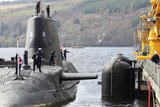
Four Dreadnought-class submarines are being built for the UK Royal Navy (Image: Crown Copyright)
Babcock has won contracts worth more than £120 million to support the development and delivery of the Dreadnought-class submarines for the UK’s Royal Navy.


Babcock will provide input into the development of the support solution for the UK’s future Dreadnought-class submarines and Weapon Handling and Launch System (WHLS) and Submerged Signal Ejector equipment for the class’s second, third and fourth boats.
Dreadnoughts will replace the Vanguard-class submarines in the early 2030s and fulfil the role of the UK’s ‘continuous at sea deterrent’.
One half of the deal, a four-and-a-half-year support contract worth £66 million (US$83.7 million) for the UK MoD, will see the company provide the ministry with technical and management support, engineering best practice and submarine maintenance achievability. The WHLS contract, worth £55 million, was awarded by prime contractor BAE Systems.
Related Articles
BAE Systems to support weapons on UK and US SSBNs
SSN-AUKUS contract sets foundation for future UK-Australian capability
The contracts wins have followed on from the recent signing of a five-year deal between Babcock and the MoD to support the detailed design for the new SSN-AUKUS submarines, which will replace the Astute-class hunter-killer fleet from the late 2030s.
Shephard Defence Insight noted that the UK was building four new Dreadnought-class SSBNs for the Royal Navy that will take over the nuclear deterrent role from the existing four Vanguard-class submarines.
Previously known as the Successor programme, the Dreadnought boats are being built by BAE Systems Submarine Solutions yard in Barrow.
The whole life cost of the four new submarines has been slated at £31 billion across the vessels’ 35-year service life.

More from Naval Warfare
-
![SOF Week 2026: US Navy USV completes record eight-day autonomous mission]()
SOF Week 2026: US Navy USV completes record eight-day autonomous mission
The MARTAC T38 Devil Ray USV has set a new endurance benchmark as the US Navy pushes deeper into autonomous maritime warfare.
-
![SAHA 2026: Turkey markets modular undersea systems to European buyers]()
SAHA 2026: Turkey markets modular undersea systems to European buyers
Turkey’s defence industry is pushing a class of platform and building an entire philosophy of cost-imposition around it.
-
![STM’s European wins strengthen Turkey’s naval credibility on the continent]()
STM’s European wins strengthen Turkey’s naval credibility on the continent
Turkish defence and engineering company STM is attempting to challenge Europe’s established naval primes by winning contracts from Portugal to Pakistan – with a business model built on working in any shipyard in the world.