Austal nets US Navy T-AGOS surveillance ships contract
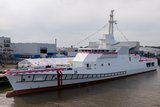
A rendering of Austal's T-AGOS design. (Image: Austal USA)
Austal USA has been awarded a contract worth up to $3.195 billion to build up to seven T-AGOS surveillance ships for the USN.


The Alabama-based shipyard has received a $113 million contract for detail design of the USN’s Auxiliary General Ocean Surveillance Ship T-AGOS 25 class.
Options under the contract for constructing up to seven ships bring its cumulative potential value to $3.195 billion.
Operated by Military Sealift Command (MSC), T-AGOS ships support anti-submarine warfare operations by offering passive and active acoustic surveillance capabilities.
Related Articles
Austal Australia converts patrol boat into unmanned vessel
Netherlands to arm ships and submarines with Tomahawk missiles
US Navy anti-sub exercise puts crewed-uncrewed teaming to the test
The 110m steel ‘small waterplane area twin hull’ (SWATH) vessels measure 110m long and gather data using Surveillance Towed-Array Sensor System (SURTASS) equipment.
The award is the latest steel shipbuilding contract for Austal USA, which also builds the USN’s Towing, Salvage and Rescue (T-ATS) ships and Auxiliary Floating Drydock Medium (AFDM).
The company is also building the USCG’s Heritage-class offshore patrol cutters (OPCs).
Austal USA has teamed with L3Harris, Noise Control Engineering, TAI Engineering and Thoma-Sea Marine Constructors to deliver T-AGOS ships from its facility in Mobile, Alabama.
Related Programmes in Defence Insight


More from Naval Warfare
-
![Five years on: where could opportunities emerge next for AUKUS Pillar II?]()
Five years on: where could opportunities emerge next for AUKUS Pillar II?
Payload commonality, combat systems and electronic warfare are emerging as likely priorities as the trilateral partnership balances building submarines with sharing industrial ecosystems.
-
![From the Baltic to the Gulf: where USV procurement is heading next]()
From the Baltic to the Gulf: where USV procurement is heading next
Saildrone’s new Copenhagen base is one sign of a larger shift, as navies globally turn to uncrewed vessels for surveillance and mine clearance.
-
![Israeli Navy looks to expand as war reshapes future force requirements]()
Israeli Navy looks to expand as war reshapes future force requirements
Israel’s navy is preparing for a larger and more technically diverse role, but its ambitions could be impacted by supply chain restrictions, accelerating demand for domestic naval production as well as autonomous maritime capabilities.
-
![Quantum sensing gathers pace as navies eye undersea advantage]()
Quantum sensing gathers pace as navies eye undersea advantage
As AI dominates defence conversations, industry increasingly points to quantum sensing as the technology set to change submarine and uncrewed underwater vehicle operations.