AUKUS nations sign naval nuclear propulsion information-sharing agreement
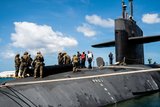
The RN’s Astute-class submarine is a contender for the basis of Australia’s future SSN. (Photo: UK MoD/ Crown Copyright)
The Australian Department of Defence said a new agreement only allows for sharing naval nuclear propulsion information and not the transfer of equipment.


AUKUS partners Australia, the UK and the US have signed an ‘Exchange of Naval Nuclear Propulsion Information Agreement’, progressing Canberra’s plans to build conventionally armed, nuclear-powered submarines.
The agreement will progress consultations, allowing the UK and US to exchange sensitive and classified nuclear propulsion information with Australia.
It will also provide a mechanism for Australian personnel to access training from US and UK counterparts to safely build, operate, and support nuclear-powered boats.
Minister for Defence Peter Dutton said: ‘This Agreement will support Australia in completing the 18 months of intensive and comprehensive examination of the requirements underpinning the delivery of nuclear-powered submarines,’
The Australian Parliament’s Joint Standing Committee on Treaties will consider the agreement and subject to domestic processes in the UK and US.
The announcement of the AUKUS agreement on 15 September shocked the world and came with the cancellation of Australia’s previous plans to buy 12 diesel-electric submarines from France’s Naval Group.
During an 18-month concept phase, the AUKUS trio will hammer out the future Australian nuclear submarine requirements.
Related Programmes in Defence Insight

You may also like
More from Naval Warfare
-
![US turns to allies to tackle navy shipbuilding backlog]()
US turns to allies to tackle navy shipbuilding backlog
A White House memorandum acknowledges US Navy shipbuilding backlogs and a weakened industrial base, opening a formal path for South Korean and Japanese yards to help rebuild capacity.
-
![US Navy’s $275 billion BBGN plan hinges on shipyard transformation]()
US Navy’s $275 billion BBGN plan hinges on shipyard transformation
The US Navy’s planned nuclear-powered warship carries a US$275 billion price tag, but the greater story lies in the industrial overhaul needed to build it, from AI-enabled design to digital twins and modular construction.
-
![Industry sees opportunity in Australia’s shift to networked undersea warfare]()
Industry sees opportunity in Australia’s shift to networked undersea warfare
Australia’s new defence innovation strategy indicates a shift from platform-centric to network-centric undersea warfare, with Ocius and Anduril Industries pointing to fast-growing opportunities for local industry.
-
![Asia-Pacific emerges as the largest export market for US-made USVs]()
Asia-Pacific emerges as the largest export market for US-made USVs
Asian customers have placed one of the largest known international purchases of US-built uncrewed surface vessels, highlighting accelerating regional demand for autonomous maritime capabilities and distributed naval operations.
-
![RTX confirms US Marine Corps and US Navy acquire Hadalus UUV]()
RTX confirms US Marine Corps and US Navy acquire Hadalus UUV
RTX told Shephard that the Hadalus UUV has been procured by the US Marine Corps and the Office of Naval Research for operational experimentation as the company prepares additional demonstrations with the US Navy, NATO and AUKUS partners.