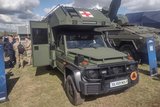
Rheinmetall Nordic’s Ragnarok mortar upgrade shows strong integration potential
The Ragnarok Mortar Mission Module has demonstrated its ability to quickly switch platforms, presenting scope for it to be employed for multiple requirements.
Lockheed Martin’s Symphony Block 40 counter-improvised explosive device (C-IED) system has been approved by the US Navy for sale to coalition and partner forces, the company announced on 26 July.
Symphony Block 40 is a vehicle-mounted jammer system that simultaneously jams select or multiple electronic signals used to trigger a radio-controlled IED. With an open-architecture design, the system provides continuous coverage across the entire threat spectrum.
The Block 10/20 variant currently supports US and coalition forces in Iraq, Afghanistan, and other areas of conflict. With this approval, the system can now be sold to partner nations under the US Foreign Military Sales programme.
Joe Ottaviano, director, electronic warfare, Lockheed Martin, said: ‘Symphony Block 40 builds on the proven performance and ten years of experience protecting warfighters. The system’s enhanced capabilities will give men and women in uniform the latest technology to counter rapidly evolving threats so they can complete their missions.’
The Ragnarok Mortar Mission Module has demonstrated its ability to quickly switch platforms, presenting scope for it to be employed for multiple requirements.
The British Army’s plans to replace thousands of vehicles have been troubled with resets, delays and change. It is possible, however, that genuine progress is being achieved on two of the three segments in the programme.
The US Army’s organic industrial base still uses World War II production methods and technologies, leading to delays and cost overruns and limiting its ability to produce critical ammunition and maintain its ground fleet in operation.
Manufacturers are speeding up their counter-drone development efforts as countries increasingly focus on procurements to provide battlefield and national protection.
Finnish company SCATA will use the Texelis Celeris chassis for a new vehicle similar to the Serval 4x4 which Texelis is building with KNDS France for the French Army.
The proposed $920 million deal would provide Sweden with a step up from its existing tube artillery and align the country with other northern European nations that have selected the HIMARS platform.