NATO tests use of “undetectable, jam-proof” laser communication in maritime scenarios
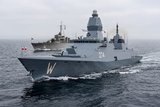
Astrolight Polaris was installed in the Portuguese Navy’s Dom Francisco de Almeida frigate. (Photo: Portuguese Navy)
As part of its effort to better prepare its capabilities for operations in contested and congested scenarios, NATO evaluated a Lithuanian ship-to-ship terminal designed to not be susceptible to enemy interference.


NATO member states recently conducted trials in naval environments with a laser-based communication capability. Supplied by the Lithuanian start-up Astrolight, the Polaris ship-to-ship terminal is an “invisible, undetectable, jam-proof” C3 data link, according to the manufacturer.
Selected for the second phase of the alliance’s Defence Innovation Accelerator for the North Atlantic (DIANA) for 2024/25, the system was tested in Portugal as part of a NATO effort to better prepare equipment for deployment in contested and congested scenarios.
Speaking to Shephard, Astrolight CEO Laurynas Mačiulis explained that Polaris provides a “less detectable, stealthier” way to communicate, enabling vessels to “securely
Our news & analysis is now part of Defence Insight®
A Basic-level or higher Defence Insight subscription is now required to view this content.




More from Naval Warfare
-
![US Navy’s MQ-25 Stingray approaches carrier-integration tests]()
US Navy’s MQ-25 Stingray approaches carrier-integration tests
Boeing has outlined its upcoming precision-landing and carrier-airspace trials as MQ-25 manufacturing shifts towards Illinois, with initial Lot 1 deliveries expected in 2029.
-
![From Poland to the Pacific: can Miecznik become a blueprint for other navies?]()
From Poland to the Pacific: can Miecznik become a blueprint for other navies?
Babcock is taking its Polish industrial partnership approach to Denmark and New Zealand as navies seek sovereign shipbuilding skills alongside ships.
-
![Unsettled waters in the North: can navies still trust their Arctic acoustic maps?]()
Unsettled waters in the North: can navies still trust their Arctic acoustic maps?
The changing Arctic environment is creating new challenges for submarine detection, driving demand for distributed sensors, uncrewed underwater vehicles and real-time acoustic modelling.