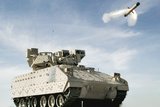
US Army receives first Digital Range Training System


Lockheed Martin has announced that it has delivered its first Digital Range Training System to the US Army and has begun development on a third range under a $13.8 million contract award. The system will now undergo live fire gunnery qualifications by armoured vehicle crews.
The Digital Range Training System provides a realistic combat environment for Abrams, Bradley and Stryker crews. Lockheed Martin was awarded the five year contract in 2011 to modernise training ranges with digital instrumentation, including cameras, targetry systems with audiovisual effects, scenario development technology and range control centres. During individual and crew qualification exercises and platoon-level collective training, the system integrates live fire with threat, neutral and friendly simulations.
According to the company, the initial range is now operational at Fort Bliss, Texas, and a second range is due for delivery to the Pohakuloa Training Area, Hawaii, in early 2013. The US Army awarded Lockheed Martin a contract for a third range in September 2012 for delivery to Fort Bliss by the end of 2013.
Jim Weitzel, vice president of training solutions for Lockheed Martin’s Global Training and Logistics business, said: ‘The quality of feedback a soldier and platoon receive about their decisions can make the difference for survivability and mission success in the field. The Digital Range Training System is designed to capture imagery and audio inside and outside vehicles from multiple angles, providing commanders and soldiers with actionable data.’


More from Land Warfare
-
![Canada accelerates uncrewed aerial system procurement for NATO and Arctic forces]()
Canada accelerates uncrewed aerial system procurement for NATO and Arctic forces
Canada plans to acquire at least 120 uncrewed aerial systems through two competitions with combined funding ceilings of C$32 million.
-
![AUSA 2026: companies adapt munitions and missiles for greater effect at lower costs]()
AUSA 2026: companies adapt munitions and missiles for greater effect at lower costs
Rather than developing entirely new weapons, defence companies are looking to build on existing weapons and systems to deliver greater capability, control costs and accelerate fielding.
-
![AUSA 2026: industry looks to make commercial platforms a military reality]()
AUSA 2026: industry looks to make commercial platforms a military reality
With a production rate of more than 10 million vehicles annually, the US commercial car and vehicle manufacturing base is second only to China. Defence companies are looking at how the vehicles, technology and manufacturing capability can support programmes.