Supacat reveals militarised Wildcat vehicle
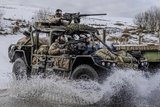
Supacat has teamed with motorsport manufacturer QT Services to develop a military version of its Wildcat 500 DKR off-road vehicle.
Revealed to reporters during a demonstration in Taunton, UK, on 26 July, the Wildcat is an ‘extremely fast’ and lightweight vehicle, and is said to be ‘roughly half the price’ of Supacat’s Jackal vehicle.
The QT Services variant of the off road vehicle has been available since 2002, and the two companies began developing the Wildcat military version some 12 months ago.
The 2.5 tonne system (with payload) is designed to fill the gap between smaller low-cost vehicles and the larger heavy ones.
One big advantage, according to Thales, which provides the weapons systems for the programme, is the speed of delivery non-military suppliers can offer.
‘They [QT] can build a vehicle like this in 12 weeks. We couldn’t even get connectors in 12 weeks in the military context,’ Gary Pilchowski, sales and marketing manager for Thales, told Shephard.
‘The weapon system has just come into service with the MoD, so it’s already on a UK programme, it’s already in service, and about to go into Afghanistan; [it is] fully stabilised.’
The 30kg weapons system is a dismountable self-protection system manufactured by Kongsberg, and this is the first purchase of the system.
‘We know the threat in theatre is either snipers or IEDs, yet we still choose to have soldiers stood up on a pintle-mount,’ Pilchowski commented.
‘The Americans have really gone into remote weapons. They are the biggest buyer of remote weapons in the world.’
Wildcat is available in both petrol and diesel variants. The civil vehicle has competed in the Paris-Dakar off-road rally, and therefore the military version is to the same standard but made more affordable.
It is designed for use by special forces, as well as for border patrol, reconnaissance, rapid intervention and strike roles.



More from Land Warfare
-
![Polaris expands Arctic mobility offering as US military orders grow]()
Polaris expands Arctic mobility offering as US military orders grow
The Military 850 Voyageur 155 Crossover has secured orders from the US Army, Air Force and Marine Corps, addressing demand for agile Arctic mobility with passenger, cargo and towing capacity.
-
![Northrop Grumman pushing ahead with smaller Integrated Battle Command System]()
Northrop Grumman pushing ahead with smaller Integrated Battle Command System
Northrop Grumman’s Integrated Battle Command System is in service with Polish forces and is being introduced to US forces, with further development underway on the original platform as well as a smaller, more mobile system.
-
![UK’s ground-based air defence effort remains in assessment phase after third industry day]()
UK’s ground-based air defence effort remains in assessment phase after third industry day
The UK’s plan to introduce a new air defence capability into the British Army will cover short and medium-range defence as well as counter-uncrewed aerial system systems. Timelines are not yet laid out but industry is making plans.
-
![K9 Thunder gains momentum across three key international markets]()
K9 Thunder gains momentum across three key international markets
Recent activity across Australia, Norway and the US highlights Hanwha Defense’s expanding presence in a self-propelled artillery market reshaped by the demands of modern warfare.