How to Enhance C2 with Interoperable Communications
Interoperable, mobile, and scalable networks are needed to meet the requirements of modern warfare


This article is brought to you by Bittium
In the ever-evolving landscape of military operations, tactical communications is a critical component that can mean the difference between mission success and failure. In this environment, effectiveness of command and control (C2) is best supported with resilient, interoperable, mobile, and scalable communications networks based on Software-Defined Radio (SDR) and IP technology.
As a forerunner in tactical communications, the Finnish company Bittium supports defense forces with high-performance and interoperable systems that provide seamless communications across the battlefield. The trusted solutions make up a significant part of the modern C5 systems of the Finnish Defence Forces, Austrian Armed Forces, and Estonian Defence Forces. Most recently, implementation of the solutions has started also with the Croatian Armed Forces’ Navy.
Mobility and scalability for large-scale warfare
The backbone for effective communications is built with Bittium’s Tactical Wireless IP Network (TAC WIN). TAC WIN is a modular SDR-based system, and with its elements MANET (mobile ad hoc network), link, and connection networks can be formed into one logical IP network quickly to support large-scale warfare.
Most times, legacy communication solutions are too hierarchical in their structure and cannot offer mobility and scalability for the network. Providing enhanced routing is one of the key factors in meeting the requirements. Bittium’s approach to routing between networks is to provide a single routing domain where single routing protocol handles the routes of the entire network. Network is flat without hierarchy, which enables always optimal route selection.
TAC WIN system is running the TAC WIN Waveform and it is designed to automatically find optimal routes for communications by using the Bittium OLSR (Optimized Link State Routing) protocol. The TAC WIN Waveform also provides interoperability with the next-generation and secure Bittium Tough SDR soldier and vehicular radios that seamlessly extend the communications to lower echelons. In addition to TAC WIN and Tough SDR platforms, the versatile Bittium Tough Comnode device also supports the same routing protocol. As the solutions are based on IP technology, interoperability with 3rd party IP-based solutions is straightforward.
Above: Bittium’s solutions use enhanced routing to support mobility and scalability of the networks (Source: Bittium)
Multi-domain and coalition interoperability
Bittium’ solutions enable broadband communications between different branches of the defense forces, for example in multi-domain operations on land and at sea. The TAC WIN backbone network at land can be extended for naval use cases on the coastline by selecting the optimal TAC WIN Radio Heads for the purpose. The network is extended further to navy vessels with Tough SDR radios using the same TAC WIN Waveform. The optimized Bittium OLSR MANET routing is supported by all the radios as well as with wired connections.
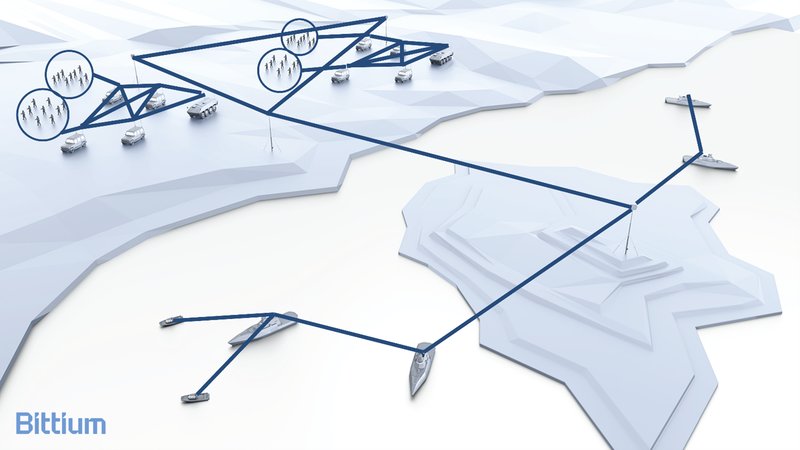
Above: Communications in multi-domain environment offers a significant advantage for command and control (Source: Bittium)
Interoperability can also be extended beyond national joint operations. NATO coalition troops achieve interoperability in tactical communications with Bittium Tough SDR radios by using the ESSOR High Data Rate Waveform (EHDRWF). The EHDRWF was adopted as a standard (STANAG 5651) by NATO in October 2023 as well as by the Federated Mission Networking as a preferred waveform for radio interoperability during operation.
Of the ESSOR participating states (Finland, France, Germany, Italy, Poland, and Spain), Finland was one of the first countries to successfully complete national approval tests with Bittium’s Tough SDR radios. In addition to Bittium, members of the a4ESSOR consortium responsible for the development of the waveform include Indra (Spain), Leonardo (Italy), Radmor (Poland), Rohde & Schwarz (Germany), and Thales (France).
More information on Bittium’s solutions is available here and at Eurosatory, Hall 6 H144 (Finnish pavilion).


More from Industry Spotlights
-
![“Start planning much earlier”: delivering defence support in an era of disruption]()
“Start planning much earlier”: delivering defence support in an era of disruption
In Conversation… The geopolitical landscape is increasingly uncertain, with the UK and its allies confronting the most unpredictable international environment for decades. To adapt, defence readiness must begin long before assets reach the front line, forging a resilient support enterprise that can thrive in a time of ongoing disruption, argue the partners of Team ORION.
-
![Patria NEMO Navy: Unlocking unmatched versatility and protection for modern naval forces]()
Patria NEMO Navy: Unlocking unmatched versatility and protection for modern naval forces
The Patria NEMO Navy mortar system marks a revolutionary advance in maritime defence technology, offering unparalleled benefits to customers who demand performance, adaptability and safety in their naval operations.
-
![“Communicating at mission speed”: why data security is essential for operational success]()
“Communicating at mission speed”: why data security is essential for operational success
In conversation… Everfox’s Chairman and Chief Executive Officer Dave Wajsgras and Managing Director, International, Colin McKinty discuss the critical importance of information security in defence, minimising insider risk and the company’s international growth strategy with Shephard’s Andrew White.
-
![“Engage with the operational problem”: how software innovation can boost UK defence]()
“Engage with the operational problem”: how software innovation can boost UK defence
In Conversation… Shephard’s Andrew White talks to Zafer Şen, CEO and co-founder of OBSS, about the future of command-and-control software in the age of artificial intelligence, and his company’s ambitions in the UK defence market.
-
![“A survivable architecture”: why resilient communications are no longer a luxury]()
“A survivable architecture”: why resilient communications are no longer a luxury
In Conversation… Military communications must adapt to a rapidly evolving battlespace, characterised by decentralised forces and an increasingly contested electromagnetic spectrum. To survive and thrive, it is vital to prioritise resilient systems and networks, Faisal Munir, President – Mission-Critical Communications at L3Harris Technologies, told Shephard’s Gerrard Cowan.