Customise your combat vehicle
Systems Integration will future-proof NATO combat vehicles.


This article is brought to you by BAE Systems
We can’t predict the future. But we can make sure our European allies are prepared for it with our modular combat systems.
There has not been a more critical moment for global security in modern times. Europe’s battlefields are evolving and, as new threats emerge, combat vehicles must stay one step ahead, seamlessly adapting to new technologies to counter emerging threats and exploit vulnerabilities. At BAE Systems, we’re pushing the boundaries to identify and integrate cutting-edge technologies that will enable our vehicles to tackle new missions and bring advanced capabilities to militaries – at the pace that modern warfare demands.
Systems integration for tomorrow’s fight
Counter-UAS systems. Active protection systems. New sensors. Advanced networking packages. Upgraded turrets. Artillery systems. Autonomy.
Based on the future threats that NATO forces will face on the battlefield, these are just a few of the technologies we’re looking to integrate onto our vehicles. Through a combination of digital engineering, systems integration expertise, and proactive teaming with industry partners and academia, these innovations will enable warfighters across the globe to take on new missions.
Systems integration is the future of our combat vehicle fleets. After going through testing and development, our vehicles currently in production are ready to integrate new capabilities that militaries need.
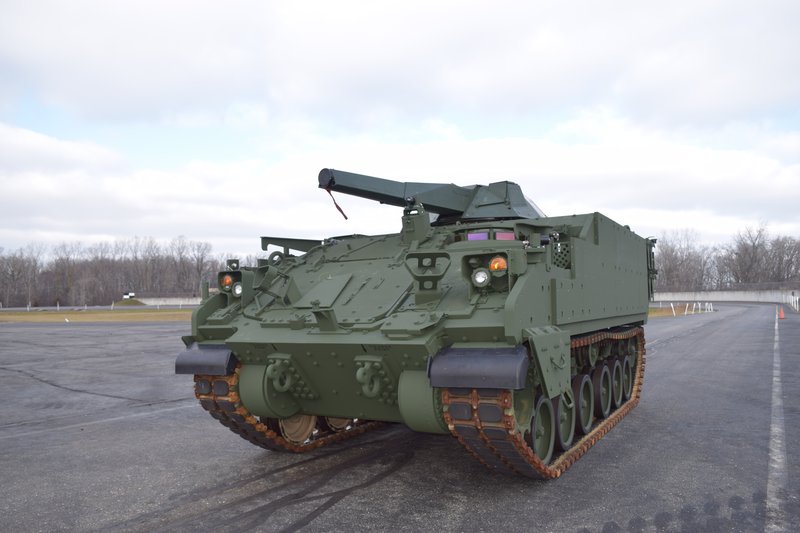
The Armoured Multi-Purpose Vehicle (AMPV) is a prime example of the sophistication we can offer. Last August, AMPV entered full-rate production. Since then, our engineers developed a common top plate for the vehicle, which can host more than 30 turrets, regardless of supplier. With the common top plate, we can partner with companies across the globe to deliver new capabilities needed on the battlefield.
To date, we have showcased four prototypes, including an AMPV prototype equipped with an unmanned turreted mortar capability from Finland-based Patria. By using the common top plate for integration, this prototype would provide Soldiers with an indirect and direct fire support platform that can be used in multi-mission scenarios. In a separate prototype effort, we also installed a counter-UAS system onto an AMPV, and successfully demonstrated it against aerial and ground targets last year.
Our ACV family is another base platform that’s ready to add new capability. This modular vehicle already has three different variants in production with a fourth vehicle, a recovery variant, in final development and test. The ACV is capable of any mission, land or sea. We’ve recently integrated and showcased a new battle management software called the Integrated Combat Solution that expedites users’ local targeting and situational awareness. We also tested advanced command and control systems, as well as counter-UAS and sensor technologies on-board the ACV. This is another platform that’s rich in opportunity – with significant potential in Size, Weight, Power and Cost advantages – and hungry for the integration of new tech.
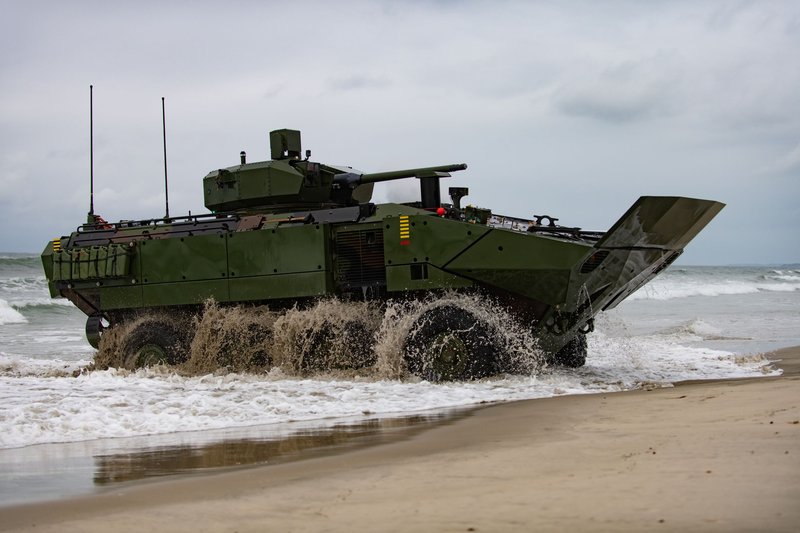
What do these two vehicles have in common? They are designed and fielded with the modularity required to easily integrate new technologies to tackle new missions, instead of spending years developing all-new vehicles.
The Need for Speed
Systems integration will be central to ensuring that NATO forces receive new capability quickly. Militaries cannot wait 10 years for new vehicle programmes to reach full-rate production. They need capability to be integrated onto existing platforms at the pace the battlefield demands.
Our aim as a systems integrator is to drastically reduce capability insertion timelines. We rely on digital engineering and work through integration challenges in a digital environment, prior to physical integration on top of a vehicle, and even simulate how other upgrades will impact the performance of a vehicle.
Our approach moving forward is simple: We’ve developed base platforms, which are ready now to integrate the technologies that our allies need for the battlefield today, and the future tomorrow.

More from Industry Spotlights
-
![Orchestrating operational readiness across every defence domain]()
Orchestrating operational readiness across every defence domain
Are all systems ready for the next mission? Have upgrades been applied? Are all assets aligned to deploy together, on time and fully prepared? In modern defence operations, readiness is no longer measured platform by platform. It is measured by how well people, assets, data and decisions move together — across land, sea and air.
-
![Extending mission readiness: where XR adds real value in pilot, crew and maintenance training]()
Extending mission readiness: where XR adds real value in pilot, crew and maintenance training
Extended reality (XR) is becoming increasingly relevant in military aviation training, adding a flexible layer to an integrated ecosystem spanning the pilot, crew, and maintenance domains.
-
![Dominating the spectrum: ASELSAN’s EW capabilities take center stage at MSPO 2026]()
Dominating the spectrum: ASELSAN’s EW capabilities take center stage at MSPO 2026
ASELSAN is showcasing its advanced electronic warfare (EW) capabilities at MSPO 2026, highlighting technologies designed to detect, analyse, disrupt and deceive threats across increasingly contested electromagnetic environments.
-
![“Creating a decision advantage”: how C-UAS is evolving to reduce the operator burden]()
“Creating a decision advantage”: how C-UAS is evolving to reduce the operator burden
In Conversation… Speaking to Shephard’s Gerrard Cowan, Dr Brian Shand, Director – Advanced Concepts & Technology at L3Harris, explains how, as operators face growing numbers of low-cost drones, C-UAS providers must focus on reducing operator workload, transforming fragmented sensor data into effective decision-making.
-
![Shield the warfighter, win the fight (video)]()
Shield the warfighter, win the fight (video)
BAE Systems’ Intrepid Shield™ approach delivers full-spectrum electromagnetic protection to detect, exploit, and counter advanced threats.
-
![How joint ventures are expanding Rheinmetall's munitions portfolio (video)]()
How joint ventures are expanding Rheinmetall's munitions portfolio (video)
Roman Köhne, CEO of Rheinmetall's Weapon and Ammunition Division, discusses the company's announcements at Eurosatory 2026, including developments in defence technology, precision systems, industrial partnerships and future capability programmes.