Spanish Army acquires advanced mobile CBRN laboratory
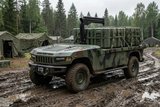
Indra mobile chemical analysis laboratory. (Photo: Indra)
The system enhances the protection provided by the Spanish Army’s CBRN regiment to soldiers and civilians in the most complex conflict scenarios.


The Spanish Army has acquired an advanced mobile chemical analysis laboratory to equip its 1st CBRN Defence Regiment. The announcement was made on 17 March by the supplier Indra.
The system is mounted on a military truck and complies with NATO STANAG 4632 standards for CBRN installations, Indra noted in a statement. It provides a safe space with negative pressure in which two or three experts can work on sample collection and analysis.
An advanced information and communications system will allow them to coordinate with the Marañosa Institute of Technology’s Central Chemical Weapons Laboratory (LQCA).
The 1st CBRN Defence Regiment is responsible for establishing a rapid alert system in the case of nuclear, biological or chemical attacks.
So far, this unit has operated mainly VAMTAC reconnaissance vehicles and BMR 6x6 armoured vehicles adapted for the mission with Sampling and Identification of Biological, Chemical and Radiological Agents (SIBCRA) Equipment.
The Spanish Army has been seeking ways to improve its CBRN systems since the outbreak of the COVID-19 pandemic in 2020.
Related Equipment in Defence Insight



More from Land Warfare
-
![Clearer military requirements could unlock UGV market growth]()
Clearer military requirements could unlock UGV market growth
Western armies continue to test uncrewed ground vehicles, but wider procurement will depend on turning ambitions for autonomy into defined operational roles and funded requirements.
-
![Can NATO’s CUAS marketplace turn urgent demand into deliveries?]()
Can NATO’s CUAS marketplace turn urgent demand into deliveries?
Framework contracts and leasing options aim to shorten acquisition timelines, while manufacturing partnerships could help suppliers scale production to meet allied demand.
-
![A medium UGV market emerges as the US weighs up its options]()
A medium UGV market emerges as the US weighs up its options
The US is pursuing multiple UGV programmes, from commercial robotic platforms to new autonomy technologies. The combination of these efforts could prove key to turning ambition into operational capability.
-
![NATO looks for answers to overcome standards hurdles and improve procurement]()
NATO looks for answers to overcome standards hurdles and improve procurement
NATO is looking to artificial intelligence to provide integration between different C2 systems to create a common operational picture, potentially offering a faster route to interoperability than the slow-moving processes of NATO standards committees.
-
![NATO FUSE exercise plays out real-world scenario in the face of eastern border risks]()
NATO FUSE exercise plays out real-world scenario in the face of eastern border risks
The large-scale exercise in Latvia was the culmination of three experimentation initiatives to see how platforms, weapons and systems could fit into the alliance’s Eastern Flank Deterrence Initiative. As well as forces, it brought together companies and equipment.
-
![Canada accelerates uncrewed aerial system procurement for NATO and Arctic forces]()
Canada accelerates uncrewed aerial system procurement for NATO and Arctic forces
Canada plans to acquire at least 120 uncrewed aerial systems through two competitions with combined funding ceilings of C$32 million.