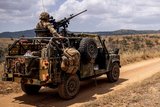
SAIC wins Assault Amphibious Vehicle support work


Science Applications International Corporation (SAIC) will engineer, design and test upgrades of prototype and low-rate initial production (LRIP) vehicles for the US Marine Corps’ legacy Assault Amphibious Vehicle (AAV) Personnel Carrier Variant Platform programme under a new contract announced on 27 May. The multiple-award, firm fixed-price contract was awarded by the USMC Program Executive Office - Land Systems (PEO-LS).
The AAV platform is designed to deliver soldiers from ‘ship to shore to objective’. The highly mobile amphibious vehicle is capable of assaulting any shoreline from the well decks of naval assault vessels. Its tracked and armoured design then provides for the transport of marines and cargo through hostile territory.
SAIC’s work on the contract includes updates of ten prototype and 52 LRIP AAV vehicles to provide improved protection while gaining back land and water mobility that improves the AAV’s ability to fight.
Tom Watson, senior vice president and general manager of the navy and marine corps customer group, said: ‘SAIC’s approach builds upon its successful support to similar vehicles, such as the AAVC7 and Mine-Resistant Ambush Protected class of combat vehicles. SAIC’s past performance demonstrates its ability to adhere to schedule, improve existing vehicles from assembly to integration and test, and still reduce risk and cost.’
The contract has a 10-month period of performance and an initial contract value of $16 million to execute preliminary and critical design reviews. Additional options for prototype vehicle build and testing followed by low rate initial production may be exercised, resulting in a total contract value of more than $192 million over five years.

More from Land Warfare
-
![Hanwha debuts with US Army deal worth up to $3.6 billion as it eyes future M109 replacement]()
Hanwha debuts with US Army deal worth up to $3.6 billion as it eyes future M109 replacement
The Mobile Tactical Cannon is to replace the US Army’s M777 towed howitzers which could result in the procurement of almost 500 systems at an estimated $3.59 billion.
-
![US pours another $23 billion into Arsenal of Freedom to ramp up missile production]()
US pours another $23 billion into Arsenal of Freedom to ramp up missile production
The US Department of Defense (DoD) is spending billions of dollars to accelerate missile production to meet demands from the war against Iran and requirements in Ukraine. Manufacture of SM-3 and PAC-3 interceptors is being ramped up, alongside a $22.9 billion commitment to Tomahawk cruise missiles.
-
![Rheinmetall advances longer 155mm ordnance with 30% range increase]()
Rheinmetall advances longer 155mm ordnance with 30% range increase
Rheinmetall has begun initial firing trials of a new 155mm/60-calibre artillery ordnance that could deliver up to 30% greater range than its existing 155mm/52-calibre system, as production of the current gun expands across Germany and the UK.
-
![Trans-European iMUGS2 uncrewed systems programme set for three-day exercise in 2028]()
Trans-European iMUGS2 uncrewed systems programme set for three-day exercise in 2028
The next stage of the Integrated Modular Unmanned Ground System (iMUGS) programme, dubbed iMUGS2, was launched in November 2025. Three major demonstrations are planned before the end of 2028.
-
![British Army Land Rover replacement plan inches forward]()
British Army Land Rover replacement plan inches forward
The UK Ministry of Defence has proposed a selection date of May 2027 for the Land Rover replacement requirement, with deliveries expected through to 2036. Next month’s DVD exhibition will be a key shop window for bidders.