SAHA 2026: Is the Turkish Army’s Altay MBT finally ready?
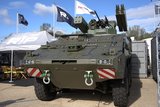
The third Altay to roll of the production line, as displayed at SAHA 2026. (Photo: author)
The centrepiece of SAHA 2026’s outdoor exhibition area was a newly minted Altay main battle tank (MBT); the third to roll off the production line, in fact. As Turkey’s first domestically developed MBT, the Altay is emblematic of wider Turkish defence ambitions.
Despite those ambitions, its development has not been a smooth process. When the first three Altays were unveiled at a special ceremony in October 2025, manufacturer BMC was keen to draw a line under any issues the platforms may have had. This message was again stressed at SAHA.
The Altay’s tortured development, however, may even surpass the highs and lows of the UK’s Ajax programme. First conceived in 2007, the Altay was initially developed by Otokar, with input from Hyundai Rotem, which signed a technology transfer agreement with the Turkish government in 2008. The first test vehicles were completed in 2012, with two prototypes delivered in 2013 and 2014. A full production contract was then expected to be awarded to Otokar in 2017.
Related Articles
New version of Altay tank to be delivered “soon” with Turkish engine for later iterations
It was at this point, though, that the platform’s development took a turn. Rather than award Otokar a full contract, the Turkish government issued a request for proposals (RfP) to BMC, FNSS and Otokar. The reasoning behind this sudden change in direction has not been disclosed, but it resulted in BMC being awarded a contract for 250 Altays in 2018. The first batch of 40 vehicles was due to be delivered within 24 months.
Under BMC, the platform then suffered a number of setbacks; some political and others industrial. Firstly, BMC had intended to use a German powerpack until it could develop a domestically produced alternative. However, it was unable to secure an export licence. Turkish involvement in the Syrian civil war had strained relations with Germany, ultimately resulting in a German arms embargo on Turkey. This forced BMC to seek an alternative. An attempt to secure a replacement from Mitsubishi Heavy Industries was also declined, again because of Japanese export restrictions.
To resolve the issue, BMC signed a deal with Doosan and S&T Dynamics in March 2021 to secure a Korean-made powerpack, but industrial issues on Doosan’s part further delayed the delivery of these powerpacks. A Ukrainian-made system was briefly considered in late 2021; however, the full-scale Russian invasion in February 2022 rendered this a non-starter. It would not be until 2023 that BMC was able to secure delivery of Korean powerpacks from S&T, two years after delivery was due to have commenced.
BMC was also initially unable to secure armour for the platform. This was to be sourced from France, but political tensions over Turkey’s posture in the Mediterranean prevented these efforts. An alternative would eventually be sourced from South Korea based on the K1.
Shephard also understands from industry insiders that Altay’s gun barrel was initially coated with substandard material, as the desired chrome plating could not be procured from Germany due to the same export restrictions. As a result, initial models were prone to misfiring, as repeated use rapidly degraded the barrel’s interior.

While these issues were ongoing, BMC was also reportedly suffering from financial difficulties stemming from insufficient cash flow, casting further doubt on Altay’s viability.
Despite these setbacks, the Altay has trundled on, with mass production commencing in May 2024 and the first three vehicles formally handed over to the Turkish army in October 2025.
Export opportunities after Turkish delivery
Speaking to Shephard at SAHA 2026, a BMC spokesperson was keen to stress that the platform had now resolved its issues. The necessary Korean powerpacks have been delivered, while a Turkish equivalent is in active development. Although he could not comment on specifics, he was keen to stress that the gun barrel issues have also been resolved.
Furthermore, BMC was keen to highlight that it is now exploring export opportunities, with negotiations with Uganda and Oman having taken place. Discussions with Oman appear to be particularly advanced, as BMC confirmed to Shephard that the Altay has conducted live-fire demonstrations in the country. BMC also said there was interest from the other Turkic republics, with Azerbaijan as the most likely contender.
Questions remain, however, about the Altay’s long-term viability. BMC told Shephard that 14 vehicles will be delivered by the end of 2026. Given that more than 40 were supposed to have been delivered five years ago, at the current delivery rate, it will be the end of the next decade before all 250 are delivered. By then, the Altay may already be at risk of obsolescence as other countries develop next-generation platforms. This raises serious questions about whether Turkey will actually procure the remaining 750 Altays that are currently planned.
Additionally, export deliveries seem to be a distant possibility at present. Given that the Altay is intended to replace Turkey’s obsolete M60s, and even older M48s, it is unlikely that Turkey will want to export the platform until it has enough in its own arsenal to be effective. As such, even if export contracts are awarded in the next few years, it would likely be the mid-2030s before any vehicles are actually delivered.
While the Altay does appear to have overcome its initial hurdles, many questions still remain. Given its repeated delays and slow production cycle, it remains to be seen if it can match the lofty ambitions set for it.
Related Programmes in Defence Insight
Altay MBT (Future Batches) [Turkey]
Related Equipment in Defence Insight
More from Country-focused updates
-
Can Portugal solve NATO’s uncrewed systems development challenge?
NATO has spent more than a decade building one of the world’s most sophisticated maritime uncrewed experimentation ecosystems, but still lacks a way to translate this testing into alliance-wide operational capability. Portugal now believes it has the answer.
-
Eurosatory 2026: Locally produced loitering munition destined for UAE Navy, says MBDA
The contract signed between MBDA and Fly-R will see diamond-shaped loitering munitions developed and prepared in the UAE. How does this move fit into wider market trends in the region?
-
Eurosatory 2026: MBDA and Thales look to civilian industry for loitering munition scale-up
Thales and MBDA have taken steps to ensure the mass production of their respective loitering munition offerings at Eurosatoy, teaming with civilian manufacturers. These moves come amid France’s push towards sovereign drone production and continued market expansion.
-
Eurosatory 2026: IDV expands with new Viking and CL2X UGV
At Eurosatory 2026, uncrewed ground vehicles (UGVs) are front and centre of IDV’s display, with a new variant of the Viking and the new CL2X on show.
-
Eurosatory 2026: L3Harris prepares ground for future Polish AEW&C replacement
L3Harris is positioning its AERIS X aircraft and a planned Polish industrial partnership as it anticipates a competition to replace Poland’s Saab 340 fleet.
-
Eurosatory 2026: France presses ahead with A400M ISR fleet upgrades
Airbus Defence and Space and OCCAR (Organisation for Joint Armament Cooperation) signed a contract at Eurosatory to develop new capabilities for the French Air Force’s A400M aircraft.