Rheinmetall Mission Master fires Thales 70mm guided rockets
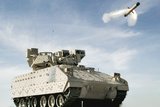
Mission Master Autonomous A-UGV equipped with Thales laser-guided FZ275 rockets. (Photo: Rheinmetall)
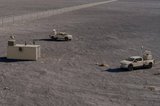
The UGV hit a 4x4 vehicle located 4 km away from the firing point during a live-fire exercise at the Trängslet base in Sweden.


Rheinmetall’s Mission Master Autonomous Unmanned Ground Vehicle (A-UGV) has used Thales laser-guided FZ275 rockets at the Trängslet base in Sweden during a live-fire exercise that was witnessed by delegations from Belgium, Denmark, Sweden, Norway, the Netherlands and Poland.
The A-UGV was equipped with a Rheinmetall Fieldranger Multi remote weapons station armed with two seven-tube 70mm rocket launchers from Thales Belgium.
For the demonstration, Mission Master fired Thales 70mm laser-guided rockets at a 4x4 vehicle located 4km away from the firing point. The exercise marked the culmination of the qualification process for the Fieldranger Multi equipped with FZ275 rockets.
Previously limited to aircraft, these area saturation and precise strike applications can engage stationary and mobile targets at ranges of up to 7km with minimal collateral damage.
According to a 7 April press release from Rheinmetall, this new configuration is now ready to be integrated into other types of platforms and armoured vehicles.
Featuring a fully modular architecture, this A-UGV can also be equipped with 12.7mm calibre machine guns, a Dillon Aero M134D gun or 40mm grenade launchers.
The Rheinmetall Mission Master SP-Fire Support is part of the A-UGV family developed by Rheinmetall Canada.
Related Equipment in Defence Insight




More from Land Warfare
-
![Front-line support: how UK industry is helping tackle Ukraine’s landmine challenges]()
Front-line support: how UK industry is helping tackle Ukraine’s landmine challenges
Pearson Engineering has provided equipment and engineering expertise to the Armed Forces of Ukraine since the beginning of the full-scale Russian invasion in 2022. The British company is now working to deepen engagement with the Ukrainian defence industry, expanding its support for the country’s population and laying the foundations for future technological innovation.
-
![AUSA 2026: companies adapt munitions and missiles for greater effect at lower costs]()
AUSA 2026: companies adapt munitions and missiles for greater effect at lower costs
Rather than developing entirely new weapons, defence companies are looking to build on existing weapons and systems to deliver greater capability, control costs and accelerate fielding.
-
![With changing patterns in Middle Eastern procurement, is Europe missing out?]()
With changing patterns in Middle Eastern procurement, is Europe missing out?
Traditional suppliers are struggling to meet the Middle East’s armoured vehicle modernisation needs, creating opportunities for South Korean manufacturers and regional defence industries.
-
![AUSA 2026: CUAS market expands as suppliers target new threats and operational requirements]()
AUSA 2026: CUAS market expands as suppliers target new threats and operational requirements
New developments from MARSS, MyDefence, Mountain Horse Solutions and Rafael suggest that future counter-drone protection will increasingly depend on combining advanced detection, rapid interception and integrated defensive networks.