Rheinmetall expands hydrogen fuel cell activities
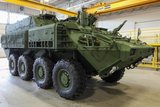
Boxer 8x8 vehicle. (Photo: Rheinmetall)
German firm Rheinmetall wants to position itself as a leader in hydrogen fuel cell technology for defence and other applications.


Rheinmetall is joining a national hydrogen fuel cell initiative in Germany as a partner in a new Innovation and Technology Centre, with financial support from the German federal government and the state of North Rhine-Westphalia.
The company has been developing and producing products for fuel cell systems for more than 20 years. In recent months alone, the company received orders in this field totalling about €50 million ($59 million).
From now on, Rheinmetall stated that it will draw on its experience and expertise in this domain to position itself even more firmly as a leader in hydrogen and fuel cell technology. This could translate into Rheinmetall upgrading some of its military vehicles, like the Boxer, with hydrogen fuel cell technologies.
Hydrogen, a key element against climate change, presents substantial global growth opportunities among all its stages (production, storage, distribution and use). The current market volume of €5 billion is predicted to exceed €100 billion by 2030.


More from Land Warfare
-
![UK hits pause on deployable mortar system procurement as US begins search]()
UK hits pause on deployable mortar system procurement as US begins search
The US Army's market survey into available 81mm and 120mm mobile mortar systems was launched only a few days after the UK suspended Project Stokes, an almost identical plan, “pending future decisions on prioritisation, resourcing and funding”.
-
![FIA 2026: MBDA launches low-cost interceptor for short-range air defence]()
FIA 2026: MBDA launches low-cost interceptor for short-range air defence
At FIA 2026, MBDA launched its Counter Mass Interceptor (CMI) which the company says is a mass-producible, low-cost effector for fire-and-forget engagements at range and altitude.
-
![Self-propelled howitzers are driving the European artillery renaissance]()
Self-propelled howitzers are driving the European artillery renaissance
After decades of force reductions as artillery was deprioritised, Europe is now undergoing an artillery renaissance as governments across the continent scramble to invest in new capabilities in response to the war in Ukraine.
-
![“Timelines are measured in seconds”: tackling the UAS threat with dispersed defences]()
“Timelines are measured in seconds”: tackling the UAS threat with dispersed defences
Small uncrewed aerial systems (UAS) have transformed the battlespace, posing a complex threat across all domains. Militaries now need counter-UAS (CUAS) capabilities that defeat the danger while meeting demands around readiness, manoeuvrability and adaptability, according to Mike Spina, Director, Global Sales and Business Development for Targeting and Sensor Systems (TSS) at L3Harris Technologies.
-
![US Army’s future autonomous launcher nears next phase with awards expected in August]()
US Army’s future autonomous launcher nears next phase with awards expected in August
The Common Autonomous Multi-Domain Launcher (CAML) is the US Army’s main effort to provide an autonomous or optionally crewed missile launcher, with more details revealed at a CSIS webinar discussion this week.