Raytheon laser takes out aerial target in groundbreaking trial with British Army
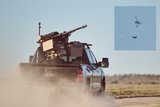
The laser was fired from a British Army Mastiff. (Photo: Raytheon)
The trial is the latest stage of the Ministry of Defence’s Land Laser Directed Energy Weapon (LDEW) demonstrator programme.


Raytheon has fired a laser against a quadcopter UAS from a British Army vehicle using soldiers trained on the weapon’s targeting and tracking technologies, an exercise described by the company as a first.
The test involved Raytheon’s High-Energy Laser Weapon System (HELWS) as part of the UK Ministry of Defence’s Land Laser Directed Energy Weapon (LDEW) demonstrator programme.
The test took place at a military range in Wales using a British Army Wolfhound armoured personnel carrier.
Related Articles
German Armed Forces successfully concludes laser weapon demonstrator trials
UK DragonFire laser weapon completes successful test
The system operates by directing a beam of energy toward its target, using advanced sensors and tracking systems to maintain lock-on and accuracy in real time.
According to Raytheon “it has proved effective in real-world conditions, validating its potential as a game-changing technology in modern warfare”.
Earlier this year, Raytheon’s HELWS was the first laser weapon integrated and fired from a land vehicle in the UK. That happened as part of a joint programme between Raytheon UK and Team Hersa, the joint LDEW enterprise between the Defence and Science Laboratory and Defence Equipment and Support.
Matt Cork, head of Team Hersa, said: “By integrating advanced directed energy technologies onto armoured platforms, we’re not only proving the feasibility of these game-changing systems but also accelerating their path to operational readiness.”
Other companies involved include Fraser Nash, NP Aerospace, LumOptica, Blighter Surveillance Systems and Cambridge Pixel. The work is occurring under a £16.8 million (US$21.5 million) contract awarded by Team Hersa.
The next steps in the project include producing learning from experience for the whole project, and using that to inform future LDEW requirements for the army.


More from Land Warfare
-
![British Army turns to local option for small robot trials]()
British Army turns to local option for small robot trials
The UK Government has ordered XRC’s small Rhino UGV for trials just weeks after placing a contract for ARX Robotics Gereon tracked UGV which will also be manufactured in the UK. The latest move is another step in creating a force of 40% uncrewed systems.
-
![SOF Week 2026: The Gear Keeping Warfighters Ready in Extreme Climates (Video)]()
SOF Week 2026: The Gear Keeping Warfighters Ready in Extreme Climates (Video)
At SOF Week 2026, Pro-Shot Defense discusses the maintenance technologies and weapon support tools designed to keep special operations forces mission ready in the world’s harshest environments.
-
![Sweden looks to commercial world to meet military UGV needs]()
Sweden looks to commercial world to meet military UGV needs
Stockholm is exploring commercial avenues to provide a small uncrewed ground vehicle capable of carrying 500kg with a focus on challenging terrains and C2 systems.
-
![Patria TRACKX - The ultimate tracked all-terrain armoured vehicle]()
Patria TRACKX - The ultimate tracked all-terrain armoured vehicle
Patria TRACKX, the ultimate tracked all-terrain armoured vehicle, is designed to conquer the most challenging environments with ease.