Raytheon high-powered microwave completes testing
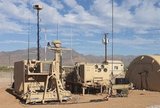
CHIMERA successfully completed a three-week field test in New Mexico, showcasing the system’s ability to defeat airborne threats at the speed of light. (Photo: AFRL)
The US Air Force’s transportable, standalone high-powered microwave (HPM) Counter-Electronic High-Power Microwave Extended-Range Air Base Defense (CHIMERA) system will play an important role in layered defence.


The US Air Force Research Laboratory and Raytheon have successfully completed a three-week field test of the CHIMERA HPM weapon at White Sands Missile Range in New Mexico.
During the test, CHIMERA applied directed energy to multiple static target variations and demonstrated end-to-end fire control by acquiring and tracking aerial targets and maintaining tracking for the entire flight path.
CHIMERA, was built to fire highly concentrated radio energy at multiple middle-to-long-range targets. The ground-based demonstration system wields more power than other HPM systems to defeat airborne threats at the speed of light.
CHIMERA has been part of the Directed Energy Front-line Electromagnetic Neutralization and Defeat (DEFEND) program, a joint service effort to design, build and test HPM systems for front-line deployment.
Raytheon has partnered with experts at the AFRL, Naval Surface Warfare Center Dahlgren Division and the Undersecretary of Defense for Research and Engineering to complete the work.
Raytheon president of advanced technology Colin Whelan said: “High-power microwave systems are cost-effective and reliable solutions that play an important role in layered defence by increasing magazine depth and giving warfighters more options to defeat adversaries quickly.”
In December 2023, Raytheon won a contract to design, build and test two HPM antenna systems that would use directed energy to defeat airborne threats at the speed of light.
Under this three-year, US$31.3 million contract from the Naval Surface Warfare Center Dahlgren Division, Raytheon will deliver prototype systems to the US Navy and US Air Force as part of the DEFEND programme.



More from Land Warfare
-
![Europe commits to long-range fires but countries move in different directions]()
Europe commits to long-range fires but countries move in different directions
Sweden, Croatia and France are pursuing different rocket artillery solutions as European armies seek greater reach, survivability and industrial resilience.
-
![MAAF to test Britain’s shift from armour to distributed lethality in Estonia]()
MAAF to test Britain’s shift from armour to distributed lethality in Estonia
The bilateral agreement between the UK and Estonia comes as both countries explore how dispersed troops, drones, digital targeting, anti-tank weapons and increasingly long-range fires can complement the combat mass traditionally provided by heavy armour.
-
![Polaris expands Arctic mobility offering as US military orders grow]()
Polaris expands Arctic mobility offering as US military orders grow
The Military 850 Voyageur 155 Crossover has secured orders from the US Army, Air Force and Marine Corps, addressing demand for agile Arctic mobility with passenger, cargo and towing capacity.
-
![More bidders move onto starting grid for British Army Land Rover replacement programme]()
More bidders move onto starting grid for British Army Land Rover replacement programme
The Light Mobility Vehicle segment of the UK’s Land Mobility Programme for the British Army may actually be about to make progress, or at least likely bidders seem to think so. Shephard spoke with several contenders who revealed their views on how the army should replace the ageing fleet.
-
![Northrop Grumman pushing ahead with smaller Integrated Battle Command System]()
Northrop Grumman pushing ahead with smaller Integrated Battle Command System
Northrop Grumman’s Integrated Battle Command System is in service with Polish forces and is being introduced to US forces, with further development underway on the original platform as well as a smaller, more mobile system.