Raytheon demonstrates Excalibur from G6 self-propelled howitzer


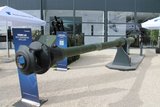
Raytheon has announced that it has fired four Excalibur 155mm precision-guided artillery projectiles from the Denel-manufactured G6 self-propelled howitzer as part of a field trial demonstration. The company made the announcement 8 May, 2012.
According to the company, multiple rounds of the Excalibur successfully fired from the G6 155mm wheeled howitzer out to a range of 38 kilometres (23.6 statute miles), with all rounds landing within 5 metres (16.4 feet) of the target. The company said the trial demonstrated Excalibur’s ability to give ‘true precision to G6 howitzers’.
Raytheon said that the US Army has demonstrated Excalibur in scenarios designed to defeat specific point targets while avoiding damage to structures, non-combatants and friendly forces. This targeting capability provides flexibility to engage at the tactical level, avoiding unintended consequences. Significantly fewer Excalibur rounds are required to defeat a target, lessening the burden of logistics.
The Excalibur 155mm precision-guided, extended-range projectile is the artillery round used in theatre by the US Army and Marine Corps. The system uses GPS precision guidance technology, providing an ‘accurate, first round, fire-for-effect capability in an urban setting’. Raytheon calls the system ‘a true precision weapon, impacting at a radial miss distance of 6 metres from the target.’


More from Land Warfare
-
![US pours another $23 billion into Arsenal of Freedom to ramp up missile production]()
US pours another $23 billion into Arsenal of Freedom to ramp up missile production
The US Department of Defense (DoD) is spending billions of dollars to accelerate missile production to meet demands from the war against Iran and requirements in Ukraine. Manufacture of SM-3 and PAC-3 interceptors is being ramped up, alongside a $22.9 billion commitment to Tomahawk cruise missiles.
-
![Boxer lands another order as contracts and opportunities build momentum]()
Boxer lands another order as contracts and opportunities build momentum
As Germany prepares its €25 billion order under the Arminius framework – the biggest Boxer procurement to date – the platform could become an increasingly powerful contender in European competitions.
-
![Trans-European iMUGS2 uncrewed systems programme set for three-day exercise in 2028]()
Trans-European iMUGS2 uncrewed systems programme set for three-day exercise in 2028
The next stage of the Integrated Modular Unmanned Ground System (iMUGS) programme, dubbed iMUGS2, was launched in November 2025. Three major demonstrations are planned before the end of 2028.
-
![British Army Land Rover replacement plan inches forward]()
British Army Land Rover replacement plan inches forward
The UK Ministry of Defence has proposed a selection date of May 2027 for the Land Rover replacement requirement, with deliveries expected through to 2036. Next month’s DVD exhibition will be a key shop window for bidders.
-
![Snow patrol and access all areas: the Arctic all-terrain vehicles market grows]()
Snow patrol and access all areas: the Arctic all-terrain vehicles market grows
The procurement and planned procurement of articulated tracked all-terrain vehicles is being driven by a need to replace older platforms and an acknowledgement of a capability gap for Arctic regions.