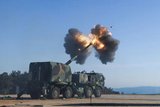
Armenia uses Serbian G-2000 rockets in Nagorno-Karabakh


Heavy fighting between Armenian and Azerbaijani forces is continuing in Nagorno-Karabakh along the entire disputed frontier between the two countries.
Both sides are using almost all types of weaponry in their arsenals, such as armoured vehicles, rifled artillery, rocket artillery and UAVs.
The latest surge in fighting, which follows a flare-up in July this year, is notable for the use by Azerbaijan of Bayraktar TB2 UCAVs supplied by Turkey, which appears to be stepping up its materiel support for Baku.
On the other side, reports on social media indicate that Russian equipment is being transported to Armenia via Iran,
Our news & analysis is now part of Defence Insight®
A Basic-level or higher Defence Insight subscription is now required to view this content.


More from Land Warfare
-
![Polaris expands Arctic mobility offering as US military orders grow]()
Polaris expands Arctic mobility offering as US military orders grow
The Military 850 Voyageur 155 Crossover has secured orders from the US Army, Air Force and Marine Corps, addressing demand for agile Arctic mobility with passenger, cargo and towing capacity.
-
![More bidders move onto starting grid for British Army Land Rover replacement programme]()
More bidders move onto starting grid for British Army Land Rover replacement programme
The Light Mobility Vehicle segment of the UK’s Land Mobility Programme for the British Army may actually be about to make progress, or at least likely bidders seem to think so. Shephard spoke with several contenders who revealed their views on how the army should replace the ageing fleet.
-
![Northrop Grumman pushing ahead with smaller Integrated Battle Command System]()
Northrop Grumman pushing ahead with smaller Integrated Battle Command System
Northrop Grumman’s Integrated Battle Command System is in service with Polish forces and is being introduced to US forces, with further development underway on the original platform as well as a smaller, more mobile system.
-
![UK’s ground-based air defence effort remains in assessment phase after third industry day]()
UK’s ground-based air defence effort remains in assessment phase after third industry day
The UK’s plan to introduce a new air defence capability into the British Army will cover short and medium-range defence as well as counter-uncrewed aerial system systems. Timelines are not yet laid out but industry is making plans.