Poland receives first Gladius UAS battery
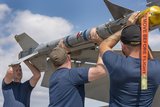
Each Gladius battery consists of nine UAVs. (Photo: WB Group)
The Polish-designed and manufactured system comprises two WB Group platforms, the FT-5 UAV, which will be used in an ISR capability and the BSP-U, an unknown platform with visual similarities to the Warmate 2.


The Polish Armed Forces has received the first elements of the Gladius reconnaissance and attack UAS just 19 months after the contract was signed with WB Group and a year after initial systems were delivered to support training and faster introduction into service.
The PLN2 billion (US$508.6 million) contract for the delivery of four Gladius battery modules of unmanned search and strike systems, along with a training and logistics package, was signed on 6 May 2022.
On 15 December 2022 the first elements of the Gladius system were delivered to the Polish Armed Forces including two UAV launchers and two Gladius training UAVs.
The system has been built around the FT-5 UAV and each battery has included four UAV BSP-U attack UAVs, five FT-5 reconnaissance UAVs, five launchers, two command vehicles and three ammunition carriers. The vehicle supporting the batteries will be the Waran 4x4 vehicle.
Under the contract the logistics package included the supply of maintenance kits and maintenance services for UAV and the training package, in addition to the training of the soldiers, including training UAVs and system simulators.
Related Programmes in Defence Insight
Related Equipment in Defence Insight

You may also like

More from Land Warfare
-
![Push strengthens for a second JLTV supplier]()
Push strengthens for a second JLTV supplier
A move, launched in May, could lead to a second supplier for the US Marines Corps’ Joint Light Tactical Vehicle requirement. Meanwhile, Wisconsin elected representatives have been pushing for necessary funding to be included in the FY27 budget.
-
![Canada reveals first requirements for future long-range air-to-air missile]()
Canada reveals first requirements for future long-range air-to-air missile
Exclusive: Ottawa says its future NORAD interceptor must be highly stealthy, resistant to jamming and capable of engaging threats at very long range, while leaving the competition open to domestic and international suppliers.
-
![July land forces roundup: UK outlines spending with details unveiled on Eurosatory vehicles]()
July land forces roundup: UK outlines spending with details unveiled on Eurosatory vehicles
Analysis of the long-awaited UK Defence Investment Plan, which was finally released on 30 June, revealed scant investment in platform replacement for the British Army. The bright spot in July, however, was a multibillion-dollar contract awarded for the British Army’s Collective Training System.
-
![Italian Army advances plans for 155m wheeled artillery fleet]()
Italian Army advances plans for 155m wheeled artillery fleet
With a requirement for 60 systems, the Italian Army is preparing to complement its tracked artillery with a modern wheeled solution based on domestic industry.
-
![Europe’s eastern flank moves on air defence radars with wider efforts also underway]()
Europe’s eastern flank moves on air defence radars with wider efforts also underway
Air defence radars have become more important assets in the past year with incursions in NATO countries on Europe’s eastern flank highlighting the need.