New Turkish 81mm mortar system ready for production after seven years in development
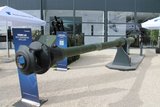
A side view of the SM-81 Keskin 81mm breech-loaded mortar showing the flat panel display fire control system. (Photo: author)
Saver Advanced Defense Technologies has unveiled a new 81mm breech-loading mortar design with a novel trigger firing mode.


Turkiye’s Saver Advanced Defense Technologies, a subsidiary of Ermaksan, has completed development of a unique pedestal-mounted breech-loaded 81mm mortar and quantity production can commence when orders are placed, according to the company.
This system has been developed over a seven-year period using internal R&D funding.
The 81mm mortar tube is 1.453m long and fitted with a hand-operated vertical sliding breech mechanism with a screw breech being one potential option.
Traverse is through a full 360 degrees with weapon elevation from -5 to +82 degrees, with both being manual with an elevation and traverse indicator being fitted.
The recoil system is mounted above
Our news & analysis is now part of Defence Insight®
A Basic-level or higher Defence Insight subscription is now required to view this content.

More from Land Warfare
-
![Boxer lands another order as contracts and opportunities build momentum]()
Boxer lands another order as contracts and opportunities build momentum
As Germany prepares its €25 billion order under the Arminius framework – the biggest Boxer procurement to date – the platform could become an increasingly powerful contender in European competitions.
-
![Trans-European iMUGS2 uncrewed systems programme set for three-day exercise in 2028]()
Trans-European iMUGS2 uncrewed systems programme set for three-day exercise in 2028
The next stage of the Integrated Modular Unmanned Ground System (iMUGS) programme, dubbed iMUGS2, was launched in November 2025. Three major demonstrations are planned before the end of 2028.
-
![British Army Land Rover replacement plan inches forward]()
British Army Land Rover replacement plan inches forward
The UK Ministry of Defence has proposed a selection date of May 2027 for the Land Rover replacement requirement, with deliveries expected through to 2036. Next month’s DVD exhibition will be a key shop window for bidders.
-
![Snow patrol and access all areas: the Arctic all-terrain vehicles market grows]()
Snow patrol and access all areas: the Arctic all-terrain vehicles market grows
The procurement and planned procurement of articulated tracked all-terrain vehicles is being driven by a need to replace older platforms and an acknowledgement of a capability gap for Arctic regions.