Netherlands to get step change in air defence capability with FFG ACSV selection
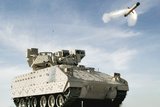
FFG ASCV with flatbed load area at the rear carrying a Rheinmetall Air Defence Systems Skyranger 30 remote controlled turret which can be dismounted for use in the static air defence role. (Photo: Rheinmetall)
FFG’s tracked Armoured Combat Support Vehicle will form the backbone of the Netherlands’ new low-level air defences, Shephard has learned, with scope for further fleet expansion beyond the initial order.


German manufacturer Flensburger Fahrzeugbau Gesellschaft (FFG) will provide its tracked Armoured Combat Support Vehicle (ACSV) platform for all elements of the new Netherlands low-level air defence system, Shephard has learned at Defence IQ’s International Armoured Vehicles (IAV) conference at Farnborough, UK.
It has also emerged that Ukraine has taken delivery of at least eight ACSVs, funded by the German government. Berlin has also funded FFG to deliver a large number of Leopard 1-based mine-clearing vehicles fitted with Pearson Engineering front-end equipment, including mine-clearing ploughs.
The Dutch order will include 18 ACSVs fitted with the Norwegian Kongsberg Defence & Aerospace NatiOnal Maneuver Air Defence System
Our news & analysis is now part of Defence Insight®
A Basic-level or higher Defence Insight subscription is now required to view this content.

More from Land Warfare
-
![AUSA 2026: companies adapt munitions and missiles for greater effect at lower costs]()
AUSA 2026: companies adapt munitions and missiles for greater effect at lower costs
Rather than developing entirely new weapons, defence companies are looking to build on existing weapons and systems to deliver greater capability, control costs and accelerate fielding.
-
![AUSA 2026: CUAS market expands as suppliers target new threats and operational requirements]()
AUSA 2026: CUAS market expands as suppliers target new threats and operational requirements
New developments from MARSS, MyDefence, Mountain Horse Solutions and Rafael suggest that future counter-drone protection will increasingly depend on combining advanced detection, rapid interception and integrated defensive networks.
-
![US Army seeks CAML-Lite autonomous launcher prototypes for 2027 live-fire trials]()
US Army seeks CAML-Lite autonomous launcher prototypes for 2027 live-fire trials
The optionally crewed, C-130-transportable platforms would combine modular offensive and defensive fires with autonomous resupply, with demonstrations planned for Talisman Sabre 2027.