Lockheed Martin awarded $756 million for long-range hypersonic weapon
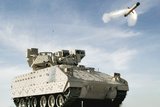
An artist’s notional rendering of the Long Range Hypersonic Weapon. (Image: Lockheed Martin)
Lockheed Martin delivered equipment for the first Long-Range Hypersonic Weapon (LTHW) battery, referred to as Dark Eagle, to US soldiers in 2021. The system has been designed to deliver additional capability for the nation’s ground-based hypersonic weapon system.


Lockheed Martin will provide additional LRHW battery equipment, systems and software engineering support, and logistics solutions to the US Army under a US$756 million contract.
The LRHW weapon system has been designed to launch the common hypersonic All Up Round (AUR) – provided by the US Navy-managed Conventional Prompt Strike (CPS) programme – and will include the army canister, a battery operations centre and transporter erector launchers.
Fiscal 2023 missile procurement, army funds in the amount of $275.3 million were obligated at the time of the award.
Related Articles
US Army advances future long-range fires
How the US Army is getting ready to succeed in contested multidomain scenarios
China turns to US-made AI chips to boost hypersonic weapon performance
In September 2019, the US Army awarded contracts for system supply related to the development of a land-based hypersonic weapon capability. Dynetics Technical Solutions (DTS) was awarded $351.6 million to produce Common-Hypersonic Glide Body (C-HGB) prototypes, while Lockheed Martin was awarded $347 million to lead the LRHW systems integration project.
The 5th Battalion, 3rd Field Artillery Regiment at Joint Base Lewis-McChord, Washington, was designated to operate the first battery of eight LRHW missiles. The battalion, also referred to as a Strategic Long-Range Fires battalion, is part of the Army’s 1st Multi Domain Task Force (MDTF), a unit in the Indo Pacific-oriented I Corps stationed at Joint Base Lewis-McChord.
According to a January 2023 Congressional Budget Office study, US Hypersonic Weapons and Alternatives, purchasing 300 Intermediate-Range Hypersonic Boost Glide Missiles (similar to the LRHW) was estimated to cost $41 million per missile in 2023 dollars.
A January 2023 Center for Strategic and International Studies report, The First Battle of the Next War: Wargaming a Chinese Invasion of Taiwan, noted when discussing hypersonic weapons “their high costs limits inventories, so they lack the volume needed to counter the immense numbers of Chinese air and naval platforms”.


More from Land Warfare
-
![Front-line support: how UK industry is helping tackle Ukraine’s landmine challenges]()
Front-line support: how UK industry is helping tackle Ukraine’s landmine challenges
Pearson Engineering has provided equipment and engineering expertise to the Armed Forces of Ukraine since the beginning of the full-scale Russian invasion in 2022. The British company is now working to deepen engagement with the Ukrainian defence industry, expanding its support for the country’s population and laying the foundations for future technological innovation.
-
![AUSA 2026: companies adapt munitions and missiles for greater effect at lower costs]()
AUSA 2026: companies adapt munitions and missiles for greater effect at lower costs
Rather than developing entirely new weapons, defence companies are looking to build on existing weapons and systems to deliver greater capability, control costs and accelerate fielding.
-
![AUSA 2026: industry looks to make commercial platforms a military reality]()
AUSA 2026: industry looks to make commercial platforms a military reality
With a production rate of more than 10 million vehicles annually, the US commercial car and vehicle manufacturing base is second only to China. Defence companies are looking at how the vehicles, technology and manufacturing capability can support programmes.
-
![With changing patterns in Middle Eastern procurement, is Europe missing out?]()
With changing patterns in Middle Eastern procurement, is Europe missing out?
Traditional suppliers are struggling to meet the Middle East’s armoured vehicle modernisation needs, creating opportunities for South Korean manufacturers and regional defence industries.
-
![AUSA 2026: CUAS market expands as suppliers target new threats and operational requirements]()
AUSA 2026: CUAS market expands as suppliers target new threats and operational requirements
New developments from MARSS, MyDefence, Mountain Horse Solutions and Rafael suggest that future counter-drone protection will increasingly depend on combining advanced detection, rapid interception and integrated defensive networks.