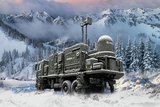
Indonesian marines get Vampir bite


The Indonesian Marine Corps conducted field tests of its new RM-70 Vampir multiple rocket launcher (MRL) system in Surabaya on 10 June.
Indonesian marines had recently received eight new units of this platform from the Czech Republic. These two batteries of MRLs contribute to Jakarta’s efforts to boost development of the country’s amphibious force.
From 12 June to 30 July, marine personnel received training on the new equipment that fires 122mm-calibre rockets. The RM-70 Vampir is an upgrade of the standard RM-70 that first appeared in 1972, with modernisation work conducted by Czech company Excalibur Army.
The weapons are mounted
Our news & analysis is now part of Defence Insight®
A Basic-level or higher Defence Insight subscription is now required to view this content.
More from Land Warfare
-
![Team Grenadier aims for success with the British Army’s LMV programme]()
Team Grenadier aims for success with the British Army’s LMV programme
Team Grenadier has unveiled the latest variant of its Grenadier 4x4, which it hopes will win the Light Mobility Vehicle segment of the army’s Land Mobility Programme.
-
![Dominating the spectrum: ASELSAN’s EW capabilities take center stage at MSPO 2026]()
Dominating the spectrum: ASELSAN’s EW capabilities take center stage at MSPO 2026
ASELSAN is showcasing its advanced electronic warfare (EW) capabilities at MSPO 2026, highlighting technologies designed to detect, analyse, disrupt and deceive threats across increasingly contested electromagnetic environments.
-
![“Creating a decision advantage”: how C-UAS is evolving to reduce the operator burden]()
“Creating a decision advantage”: how C-UAS is evolving to reduce the operator burden
In Conversation… Speaking to Shephard’s Gerrard Cowan, Dr Brian Shand, Director – Advanced Concepts & Technology at L3Harris, explains how, as operators face growing numbers of low-cost drones, C-UAS providers must focus on reducing operator workload, transforming fragmented sensor data into effective decision-making.